Solutions

Energy & Focus

Energy & focus approached at the level of mitochondrial energy production rather than stimulation — treatments prescribed only when a licensed provider determines they are appropriate for you.

Coming soon in Energy & Focus: SS-31, SLU-PP-332

How it works.

From first intake to ongoing care — a clear path, guided by a clinician.

1

Complete your intake

Share your health history, goals, and current medications in a few minutes.

2

Meet a licensed clinician

Review your goals and options with a provider experienced in peptide therapy.

3

Receive a personalized plan

If appropriate, get a custom protocol with clear, step-by-step instructions.

4

Ongoing follow-up

Regular check-ins and adjustments keep you supported and on track.

In brief.

People arrive at this category describing the same thing in different words: a flatness that sleep does not fix, a slower recovery from ordinary days, a sense that the tank refills less completely than it used to. It is one of the most common reasons anyone looks at prescription peptide therapy at all.

It is worth being precise about the word energy, because it does two jobs. This category is not about stimulation. Nothing here works the way caffeine or a prescription stimulant works, nothing here produces a lift on a schedule, and nothing here is offered as a performance enhancer. The subject is cellular bioenergetics — how mitochondria convert fuel into ATP, and what the research says about the signaling around that process.

Bioenergetics, not stimulation

A stimulant changes how alert you feel by acting on the nervous system. It does not change how much ATP a cell can make. The compounds in this category are studied at the other end of that distinction: mitochondrial function, redox balance, and the molecular sensors that tell a cell how much fuel it has and what to do about it.

That also sets expectations honestly. This is slow, structural biology, not a dose you feel. If what you want is a same-afternoon lift, this is the wrong category and a provider will tell you so.

Mitochondrial support: three compounds, three points in the same system

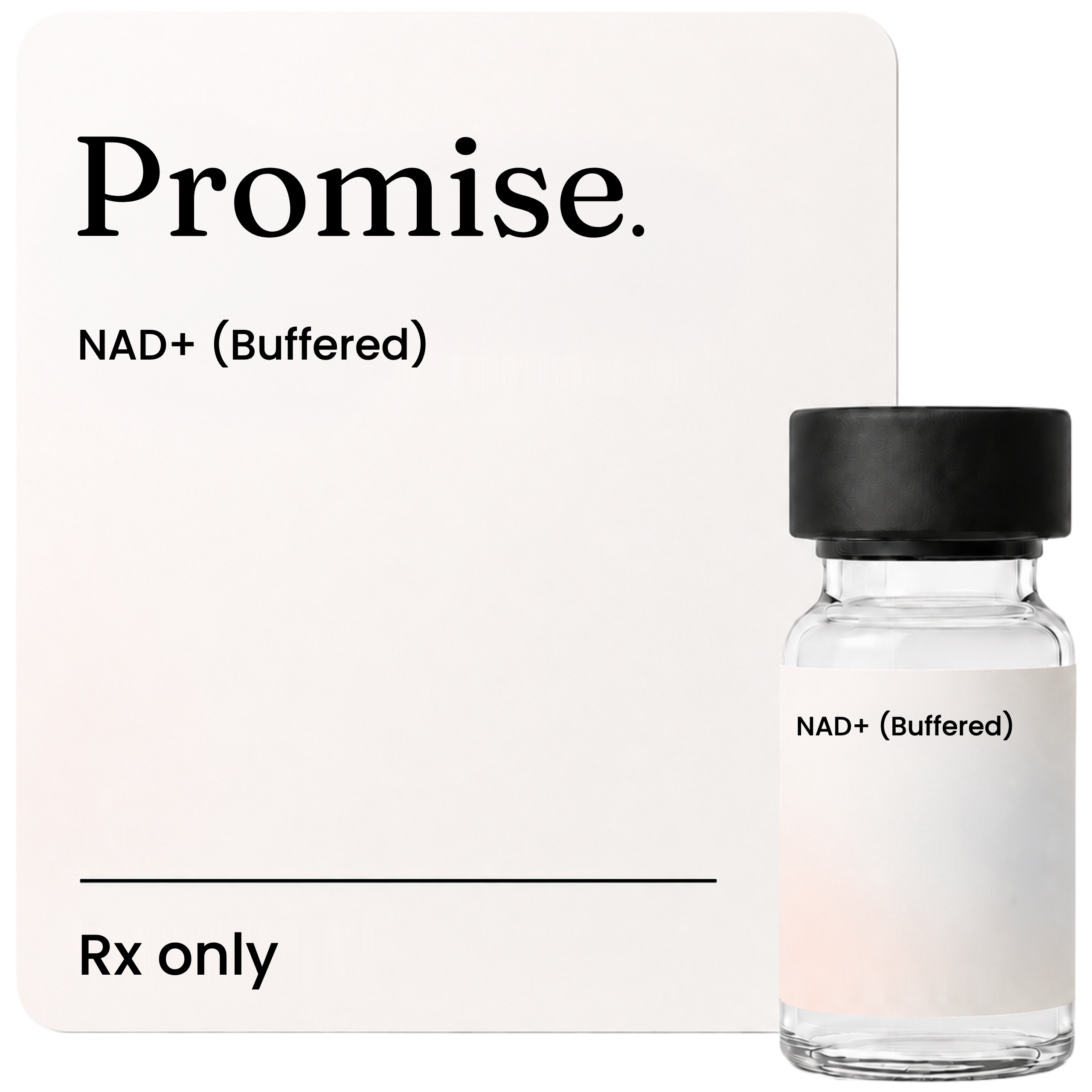
NAD+ is not a peptide at all. It is a redox coenzyme present in every cell, carrying electrons between the reactions that release energy from fuel; measured levels decline with age. Promise lists it as an injectable because oral bioavailability is the central problem with the whole category of NAD precursors.

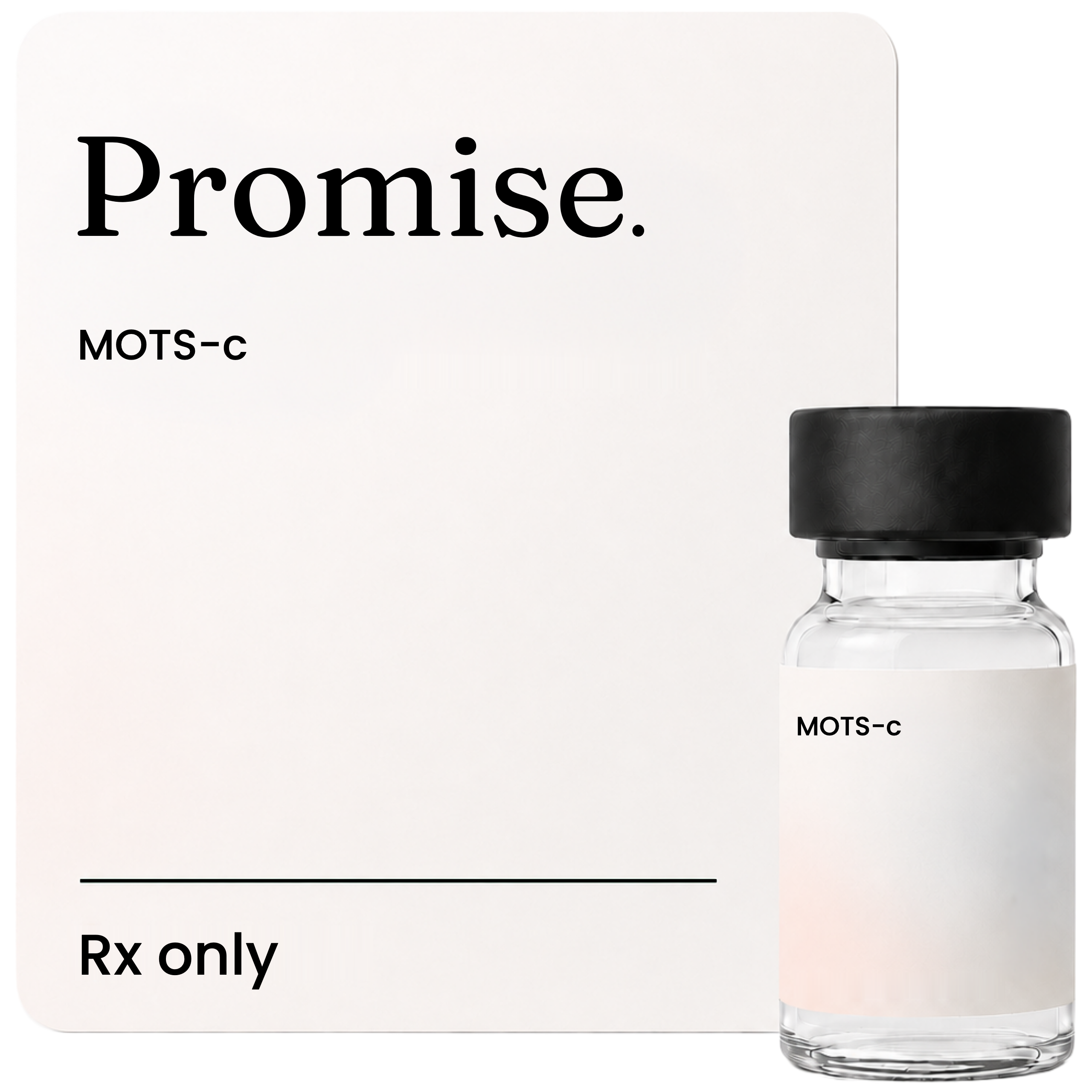
MOTS-c is a peptide encoded in mitochondrial DNA rather than in the nucleus — one of a small set of mitochondrial-derived peptides that appear to act as signals to the rest of the cell. Research interest centers on AMPK, the sensor cells use to read their own energy state.

SS-31, also known as elamipretide and coming soon to Promise, is a tetrapeptide that binds cardiolipin, a phospholipid specific to the inner mitochondrial membrane. Research interest centers on membrane structure and the efficiency of the electron transport chain — a structural angle rather than a signaling one.

What a visit involves and how a provider decides

Fatigue is a symptom with a long differential, and a good clinician starts there. Thyroid disease, anemia, sleep apnea, depression, and the side effects of medications you are already taking are all common, all treatable, and all more likely than a mitochondrial problem. A provider reviewing your intake may decline and point you toward that workup instead, which is the correct outcome, not a failure of the visit.

Each treatment has its own intake — a different clinical questionnaire per product — covering your history, medications, and what you are actually experiencing. If a prescription is appropriate, the medication is compounded and dispensed by a licensed U.S. pharmacy, with dosing instructions and follow-up. A compounded medication is different from an FDA-approved product: the formulations listed here are not FDA-approved. An FDA-approved elamipretide (SS-31) product exists for one rare genetic condition, Barth syndrome, and that approval does not extend to the compounded SS-31 Promise will offer. The human evidence behind these compounds is early; if your interest is broader than daily energy, anti-aging and longevity covers the same biology from the other direction.

Common questions

Do I need a prescription for NAD+, MOTS-c, or SS-31?

Yes. All three are prescription-only. A licensed provider reviews every request and prescribes only when treatment is medically appropriate for you.

Is NAD+ FDA-approved?

No. Injectable NAD+ is not FDA-approved, and neither is MOTS-c. The compounded SS-31 Promise will offer is not FDA-approved either, although an FDA-approved elamipretide (SS-31) product exists for one rare genetic condition, Barth syndrome; that approval does not extend to compounded SS-31. All are compounded medications, prepared for an individual patient by a state-licensed U.S. pharmacy under a provider's prescription. Compounded medications are not reviewed by the FDA for safety, effectiveness, or quality.

Will I feel more energetic right away?

This category is not built to produce a same-day lift, and it should not be described that way. These compounds are studied at the level of mitochondrial function, which is slow, structural biology. Anyone promising an immediate effect is selling something other than what this is.

Is this a stimulant?

No. Nothing here acts on the nervous system the way caffeine or a prescription stimulant does. The mechanisms under study are redox chemistry, AMPK signaling, and mitochondrial membrane structure.

What if my fatigue turns out to have another cause?

That is common, and it is what the provider looks for first. Thyroid disease, anemia, sleep apnea, depression, and medication side effects are all more likely explanations than a mitochondrial one.

Explore other solutions

Anti-Aging & Longevity

Compounded peptides studied in anti-aging and longevity research, offered the honest way: a licensed provider reviews your history and prescribes only when it is appropriate for you.

Explore Anti-Aging & Longevity →

Brain Health & Memory

Two brain-health peptides with an unusual research history, offered by prescription and described honestly — a licensed provider reviews every request.

Explore Brain Health & Memory →

Calming & Stress Relief

Calming & stress relief: compounded peptides studied around sleep architecture and stress signaling. The human evidence is limited, and a licensed provider reviews every request.

Explore Calming & Stress Relief →

Gut Health & Digestion

A compounded peptide studied for the signaling behind gut health — gastrointestinal lining integrity — prescribed only when a licensed provider determines it is appropriate for you.

Explore Gut Health & Digestion →

Hormone & Organ Health

Hormone & organ health starts upstream: peptides studied for their effect on the body's own growth hormone release, rather than supplying growth hormone itself. A licensed provider evaluates every request.

Explore Hormone & Organ Health →

Immune Support

Immune support here means one compounded peptide today, studied around T-cell maturation and immune signaling, with more coming soon. A licensed provider reviews every request.

Explore Immune Support →

Metabolic Support & Fat Loss

Incretin medications studied for fat loss and metabolic support, which a licensed provider may consider alongside nutrition, movement, and sleep. Every request is reviewed by a clinician.

Explore Metabolic Support & Fat Loss →

Mood & Libido

Compounded peptides studied for the central signaling behind mood & libido, rather than peripheral blood flow. A licensed provider reviews every request.

Explore Mood & Libido →

Muscle & Recovery

Compounded peptides studied for the signaling behind tissue repair and muscle recovery — prescribed only when a licensed provider determines they are appropriate for you.

Explore Muscle & Recovery →