Gut Health & Digestion · Rx only

BPC-157, prescribed — not just shipped.

Skip the gray-market guesswork. A licensed clinician reviews your health history, a licensed U.S. pharmacy compounds your prescription, and a care team stays with you after it ships.

$243 / mo$270 as a single month · $648 for a 3-month supply

A licensed clinician reviews every request. If BPC-157 fits your health history, they write your prescription and your pharmacy takes it from there.

Licensed U.S. providers Licensed U.S. pharmacy All 50 states + D.C.

Requires an online medical evaluation. Prescribed only when a licensed provider determines it's appropriate.

A licensed clinician in a consultation room
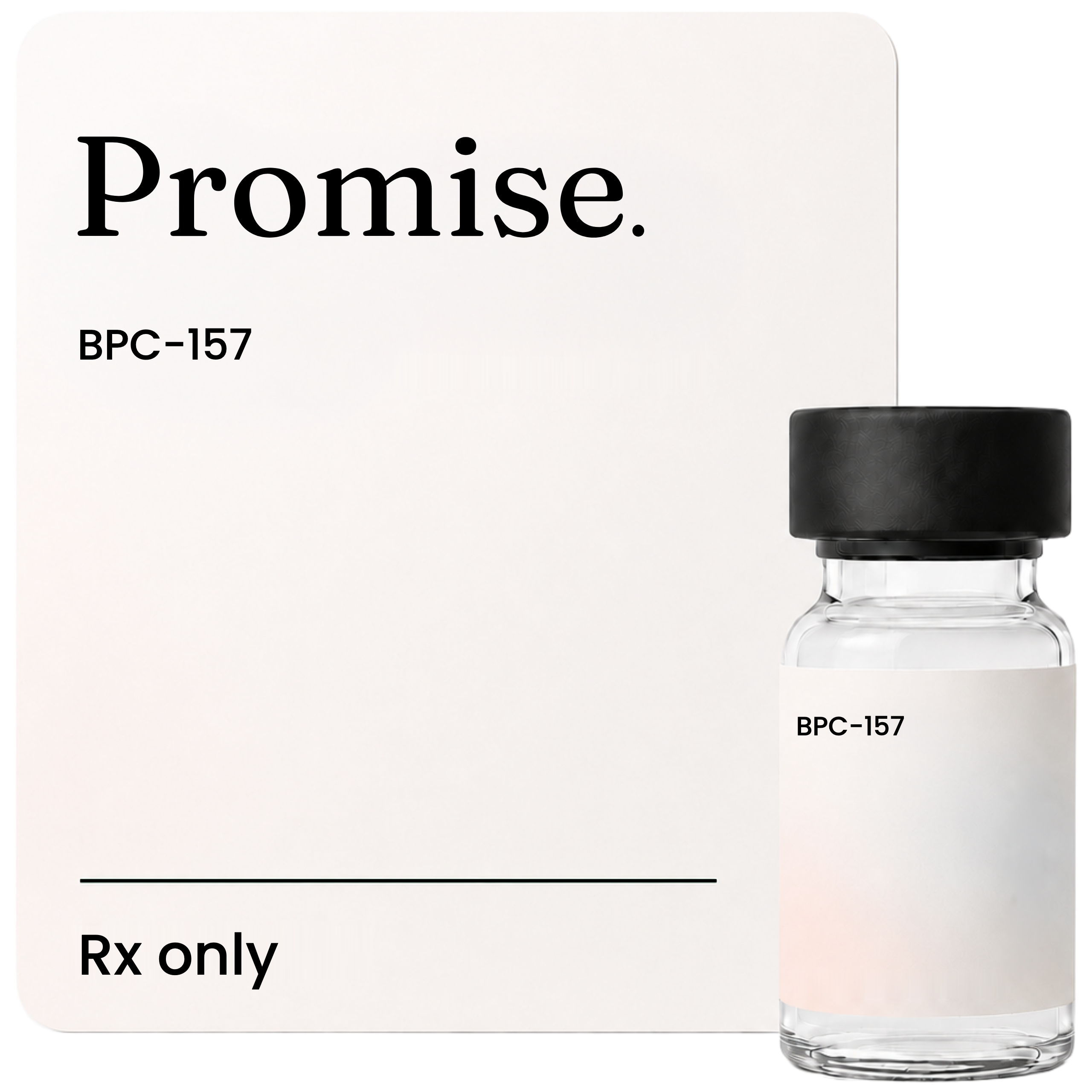
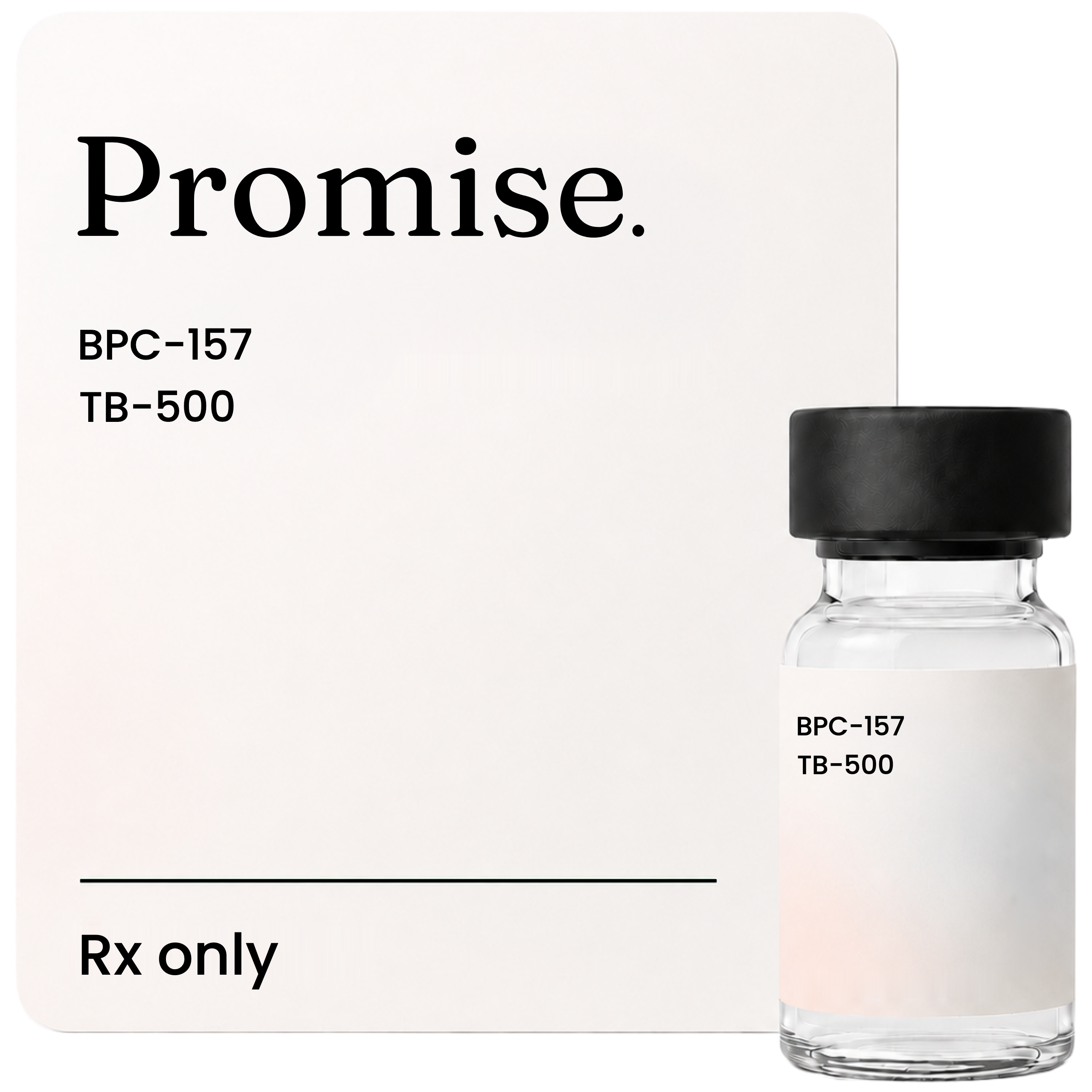
BPC-157 vial and spec card
BPC-157 · Rx only
1

Share your health history

BPC-157 has its own online clinical questionnaire — your history, medications, and goals.

2

Your answers get a careful review

A clinician reads your history and takes the time to get it right before anything is prescribed.

3

Your pharmacy ships

Compounded for your prescription and shipped cold-chain, with care-team check-ins after.

The safe way to take BPC-157 seriously

BPC-157 is easy to find online and hard to trust there. Promise works the way medicine is supposed to work — a clinician decides, a licensed pharmacy fills, and someone stays accountable to you.

A real prescription

Prescribed for you specifically, after a real look at your health history — never pulled off a shelf.

A real pharmacy

Your prescription is compounded for you by a licensed U.S. pharmacy — not a mystery vial from an unregulated website.

Real oversight

Temperature-safe shipping, follow-up check-ins, and a care team that answers — before and after your medication arrives.

Product details
Form
Injectable vial (subcutaneous)
Supply
30-day supply
Pharmacy
Compounded by a licensed U.S. pharmacy
Availability
Ships to all 50 states + D.C.; not all treatments are available in every state

Studied for repair signaling

Research interest centers on blood-vessel formation and the migration of the cells that lay down new collagen — the signals tissue uses to rebuild.
Modeled on a gut-protective protein

The sequence is drawn from a protein found in gastric juice, which is why GI-lining integrity is one of its most studied questions.

Prescribed, never simply supplied

A licensed provider reads your history, decides whether BPC-157 fits it, and sets the protocol.

In brief.

Interest in repair peptides has grown faster than the clinical evidence behind them, and BPC-157 sits right at the front of that gap. It is a 15-amino-acid synthetic peptide studied for tissue-repair signaling and for the integrity of the gut lining. Promise offers it one way only: a licensed provider reviews your health history and prescribes it only when treatment is appropriate for you.

What BPC-157 is

BPC-157, short for Body Protection Compound-157, is a chain of 15 amino acids modeled on a sequence found in a protective protein in human gastric juice. Because that parent protein does its work on the stomach lining, much of the early research interest followed it there, then widened into connective tissue: tendon, ligament, and muscle. It is the base ingredient in both of our recovery blends, Wolverine and KLOW, and it anchors our gut health and digestion category.

Being honest about the evidence matters here. Most of the published work on BPC-157 is preclinical, and human trials are limited in number and size. That is not a reason to be coy about it, but it is a reason to treat the compound as something a clinician decides on with you rather than something you decide on alone.

How it is studied to work

The research reads BPC-157 as a signaling peptide rather than a building block. Studies look at how it influences the formation of new blood vessels, which is the plumbing any repair depends on, and at the growth-factor receptors that tell repair cells where to go. Related work looks at the nitric oxide pathway, which governs blood flow, and at how fibroblasts — the cells that lay down new collagen — migrate toward a damaged area.

Its other studied line is the gut. Because the sequence comes from a gastric protective protein, researchers have examined it in models of GI-lining integrity, which is why you often see BPC-157 discussed in the same breath as digestive comfort. Mechanism is not the same as outcome, and none of this describes what will happen in any one person. It describes what is being studied, and why.

How BPC-157 is prescribed

Everything starts with an intake questionnaire built specifically for this compound: your health history, current medications, what you are trying to address. A licensed provider reads it. If BPC-157 is a reasonable fit for your history, they write the prescription and set the protocol.

Not everyone qualifies, and that gate is the point. Some people are better served by a different peptide — TB-500 is often considered alongside this one — and some are better served by no peptide at all.

What treatment looks like

If you are prescribed, your medication is compounded and dispensed by a licensed U.S. pharmacy, and shipped in discreet, temperature-safe packaging. Dosing is not a number you find online; your provider sets the protocol based on your evaluation, and you follow theirs.

From there it is check-ins. Your care team follows up, and if something needs to change, it changes with a clinician involved. BPC-157 is meant to sit on top of the fundamentals — sleep, nutrition, sane training loads — not to stand in for them. It is a support for the promise you already made to yourself, not a replacement for the work.

Common questions

What is BPC-157?

BPC-157 is a synthetic peptide of 15 amino acids, modeled on a sequence found in a protective protein in human gastric juice. It is studied for tissue-repair signaling — particularly the formation of new blood vessels and the movement of repair cells toward damaged tendon, ligament, and muscle — and for the integrity of the gut lining. Most of the published research is preclinical, and human trials remain limited, so interest in it has outpaced the clinical evidence.

Do I need a prescription for BPC-157?

Yes. BPC-157 is available through Promise only by prescription. You complete an intake questionnaire, a licensed provider reviews your health history, and they prescribe only when treatment is appropriate for you.

Is BPC-157 FDA-approved?

No. BPC-157 is not FDA-approved. It is a compounded medication, and compounded medications are not reviewed by the FDA for safety, effectiveness, or quality. It is prepared by a licensed U.S. compounding pharmacy against a prescription written for you specifically, after a licensed provider has reviewed your health history.

How does the online visit work?

You start with the intake form for BPC-157, which is its own clinical questionnaire covering your health history, medications, and goals. A licensed provider reviews your answers and prescribes only if BPC-157 is appropriate for you. If it is, your medication is compounded and dispensed by a licensed U.S. pharmacy and shipped in temperature-safe packaging, with follow-up check-ins from your care team.

How is BPC-157 different from TB-500?

They are studied at different points in the same repair process. BPC-157 is a 15-amino-acid sequence modeled on a gastric protective protein, and the research interest sits around blood-vessel formation signaling and the gut lining. TB-500 is a fragment of thymosin beta-4 and is studied mainly for its interaction with actin, the structural protein cells use to move toward damaged tissue. They are frequently studied together, which is why our Wolverine protocol pairs them, and your provider decides which of the three — if any — fits your history.