Solutions

Anti-Aging & Longevity

Compounded peptides studied in anti-aging and longevity research, offered the honest way: a licensed provider reviews your history and prescribes only when it is appropriate for you.

How it works.

From first intake to ongoing care — a clear path, guided by a clinician.

1

Complete your intake

Share your health history, goals, and current medications in a few minutes.

2

Meet a licensed clinician

Review your goals and options with a provider experienced in peptide therapy.

3

Receive a personalized plan

If appropriate, get a custom protocol with clear, step-by-step instructions.

4

Ongoing follow-up

Regular check-ins and adjustments keep you supported and on track.

In brief.

Longevity is the area of medicine where people arrive with the most hope and the least reliable information. The underlying question is a fair one — whether anything can be done about the biology of aging itself rather than only its consequences — and it is a genuinely active field. The problem is the distance between that research and the confidence with which its results get sold.

Promise takes a narrow position here. Everything in this category is a prescription medication, reviewed by a licensed provider before anything is dispensed and declined when it is not appropriate. In a category this noisy, that review is the entire answer: not everyone qualifies, and a provider saying no is the system working as designed.

Two anti-aging compounds, two very different targets

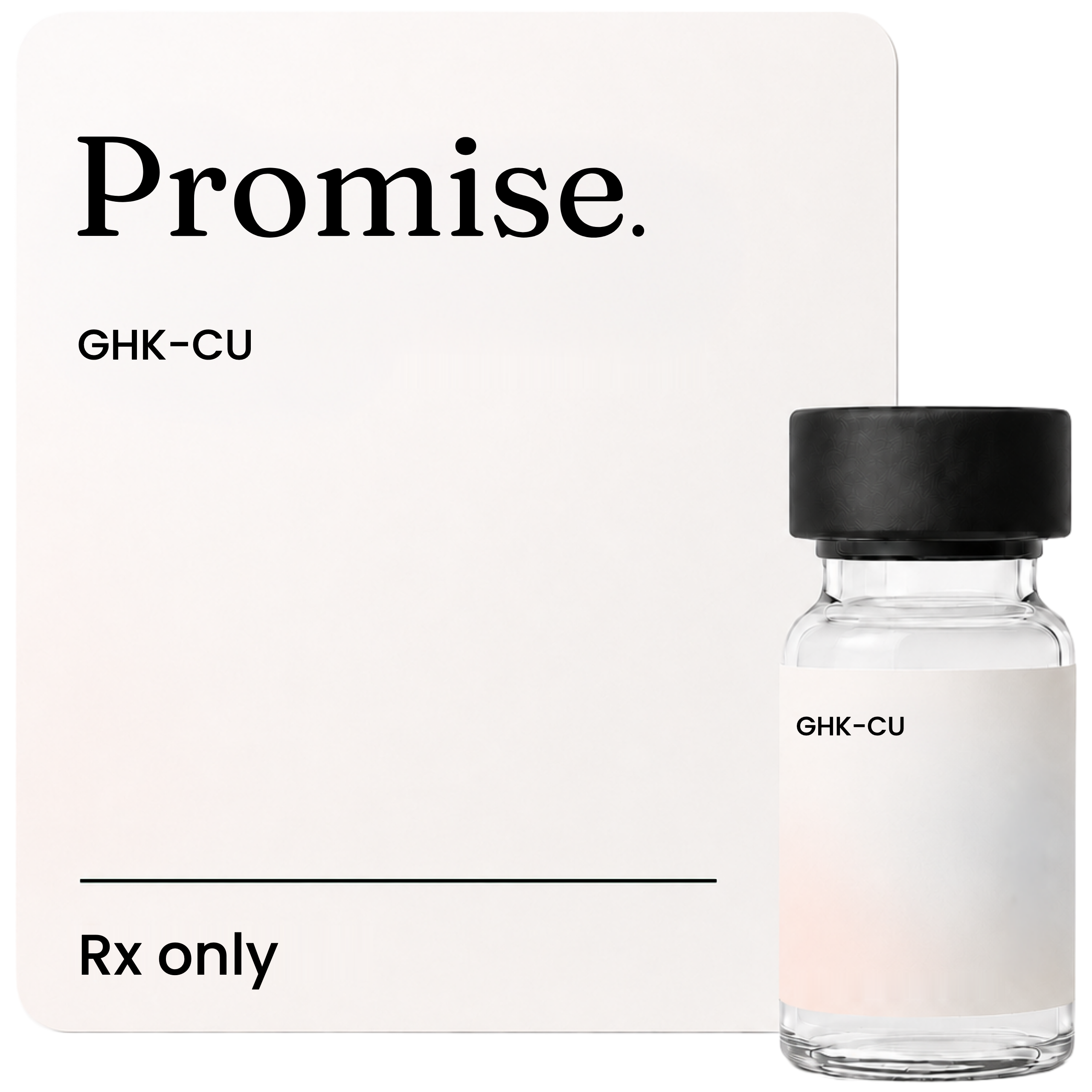
GHK-Cu is a copper-binding tripeptide that occurs naturally in human plasma, where measured levels decline with age. Research interest centers on skin and connective tissue — collagen signaling, the wound environment, and the maintenance of the matrix that supports skin structure. It is the more tangible of the two, aimed at tissue you can actually look at.

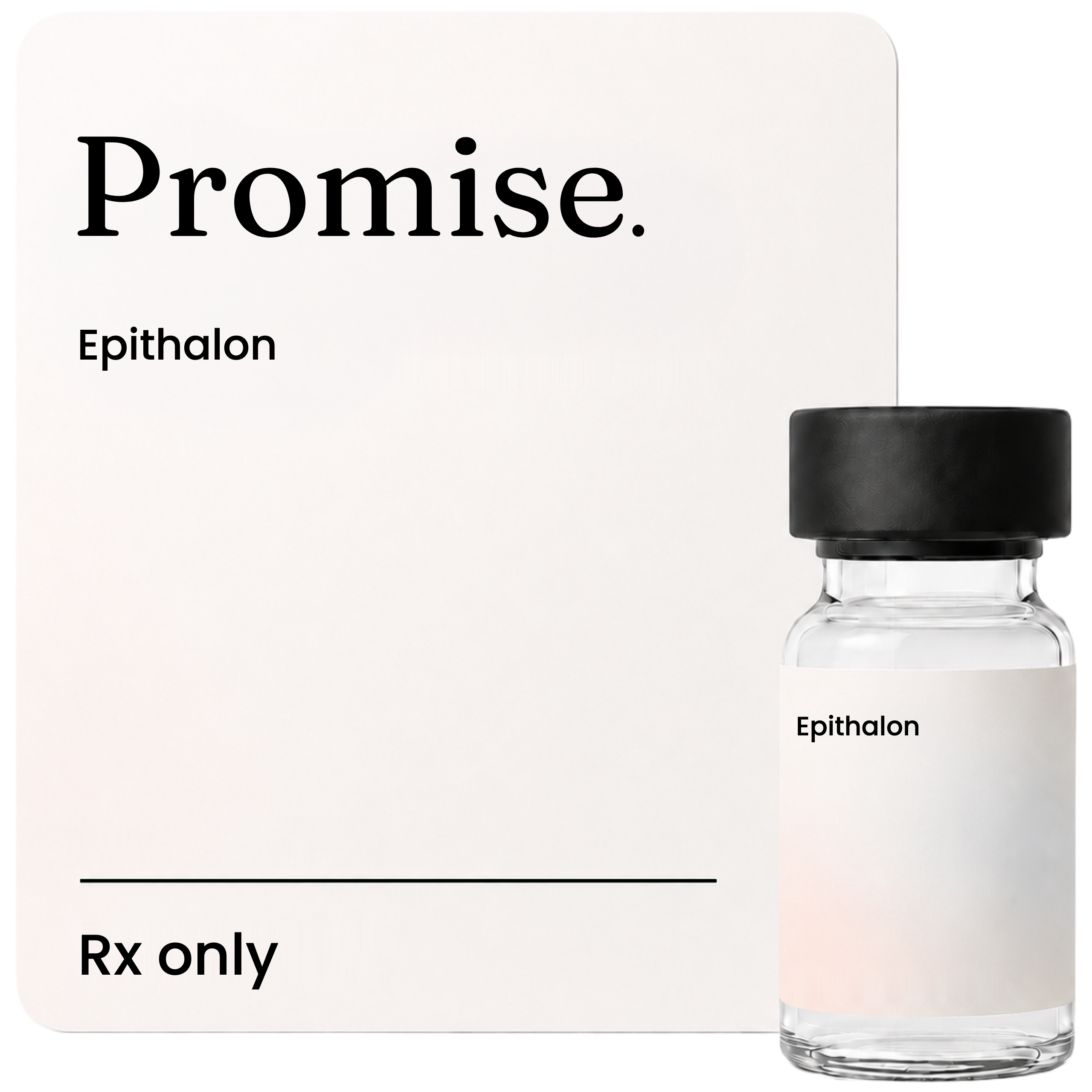
Epithalon works at a different scale. A synthetic tetrapeptide derived from a pineal gland extract, it has been studied largely around telomerase expression and cellular replication — a systemic question rather than a cosmetic one. It is also handled differently in practice: it is offered as a short one-time course rather than a recurring plan, because that is how it has been studied and used.

What the evidence does and does not support

Both compounds rest on an evidence base that is mostly preclinical — cell culture and animal models, with human work that is limited and often small. Neither is FDA-approved. Neither has been shown to extend human lifespan, and any page implying otherwise is describing something the literature does not contain.

That is not an argument against interest in this category. It is an argument for a prescriber. A provider can say where the research is genuinely promising, where it is thin, and whether either compound has any place in your situation — which is a different conversation from whether it sounds appealing.

What a visit involves and how a provider decides

You complete the intake for the specific treatment you are asking about; each one is its own clinical questionnaire. It covers your health history, your current medications, and what you are actually trying to address. Copper metabolism, existing conditions, and drug interactions all matter here, and some histories rule a compound out entirely.

If you are prescribed, the medication is compounded and dispensed by a licensed U.S. pharmacy, and shipped with instructions and follow-up from your care team. If what you are describing is closer to day-to-day fatigue than to long-term biology, energy and focus is the more useful place to start.

Common questions

Do I need a prescription for GHK-Cu or Epithalon?

Yes. Both are prescription-only. A licensed provider reviews every request and prescribes only when treatment is medically appropriate for you.

Is Epithalon FDA-approved?

No. Epithalon is not FDA-approved, and neither is GHK-Cu. Both are compounded medications, prepared for an individual patient by a state-licensed U.S. pharmacy under a provider's prescription. Compounded medications are not reviewed by the FDA for safety, effectiveness, or quality.

How do GHK-Cu and Epithalon differ?

They target different scales. GHK-Cu is a copper-binding tripeptide studied for skin and connective-tissue signaling. Epithalon is a tetrapeptide studied around telomerase expression and cellular replication. Which one a provider considers, if either, depends on your history and what you are trying to address.

Can peptides slow aging?

That is the question the research is trying to answer, and it has not answered it. Most of the work behind this category is preclinical, and the human data is limited. We would rather say that plainly than repeat claims the literature does not support.

Why is Epithalon offered as a one-time course instead of a monthly plan?

Because that is how it has been studied and used — as a defined short course rather than continuous therapy. It is offered as a single one-time course, not a recurring plan.

Explore other solutions

Brain Health & Memory

Two brain-health peptides with an unusual research history, offered by prescription and described honestly — a licensed provider reviews every request.

Explore Brain Health & Memory →

Calming & Stress Relief

Calming & stress relief is a category of one: a compounded peptide studied around slow-wave sleep architecture and stress-hormone signaling. The human evidence is limited, and a licensed provider reviews every request.

Explore Calming & Stress Relief →

Energy & Focus

Energy & focus approached at the level of mitochondrial energy production rather than stimulation — treatments prescribed only when a licensed provider determines they are appropriate for you.

Explore Energy & Focus →

Gut Health & Digestion

A compounded peptide studied for the signaling behind gut health — gastrointestinal lining integrity — prescribed only when a licensed provider determines it is appropriate for you.

Explore Gut Health & Digestion →

Hormone & Organ Health

Hormone & organ health starts upstream: peptides studied for their effect on the body's own growth hormone release, rather than supplying growth hormone itself. A licensed provider evaluates every request.

Explore Hormone & Organ Health →

Immune Support

Immune support here means one compounded peptide, studied around T-cell maturation and immune signaling. A licensed provider reviews every request.

Explore Immune Support →

Metabolic Support & Fat Loss

Incretin medications studied for fat loss and metabolic support, which a licensed provider may consider alongside nutrition, movement, and sleep. Every request is reviewed by a clinician.

Explore Metabolic Support & Fat Loss →

Mood & Libido

Two compounded peptides studied for the central and upstream signaling behind mood & libido, rather than peripheral blood flow. A licensed provider reviews every request.

Explore Mood & Libido →

Muscle & Recovery

Compounded peptides studied for the signaling behind tissue repair and muscle recovery — prescribed only when a licensed provider determines they are appropriate for you.

Explore Muscle & Recovery →