Anti-Aging & Longevity · Rx only

GHK-Cu, prescribed — not just shipped.

Skip the gray-market guesswork. A licensed clinician reviews your health history, a licensed U.S. pharmacy compounds your prescription, and a care team stays with you after it ships.

$243 / mo$270 as a single month · $648 for a 3-month supply

A licensed clinician reviews every request. If GHK-Cu fits your health history, they write your prescription and your pharmacy takes it from there.

Licensed U.S. providers Licensed U.S. pharmacy All 50 states + D.C.

Requires an online medical evaluation. Prescribed only when a licensed provider determines it's appropriate.

A licensed clinician in a consultation room
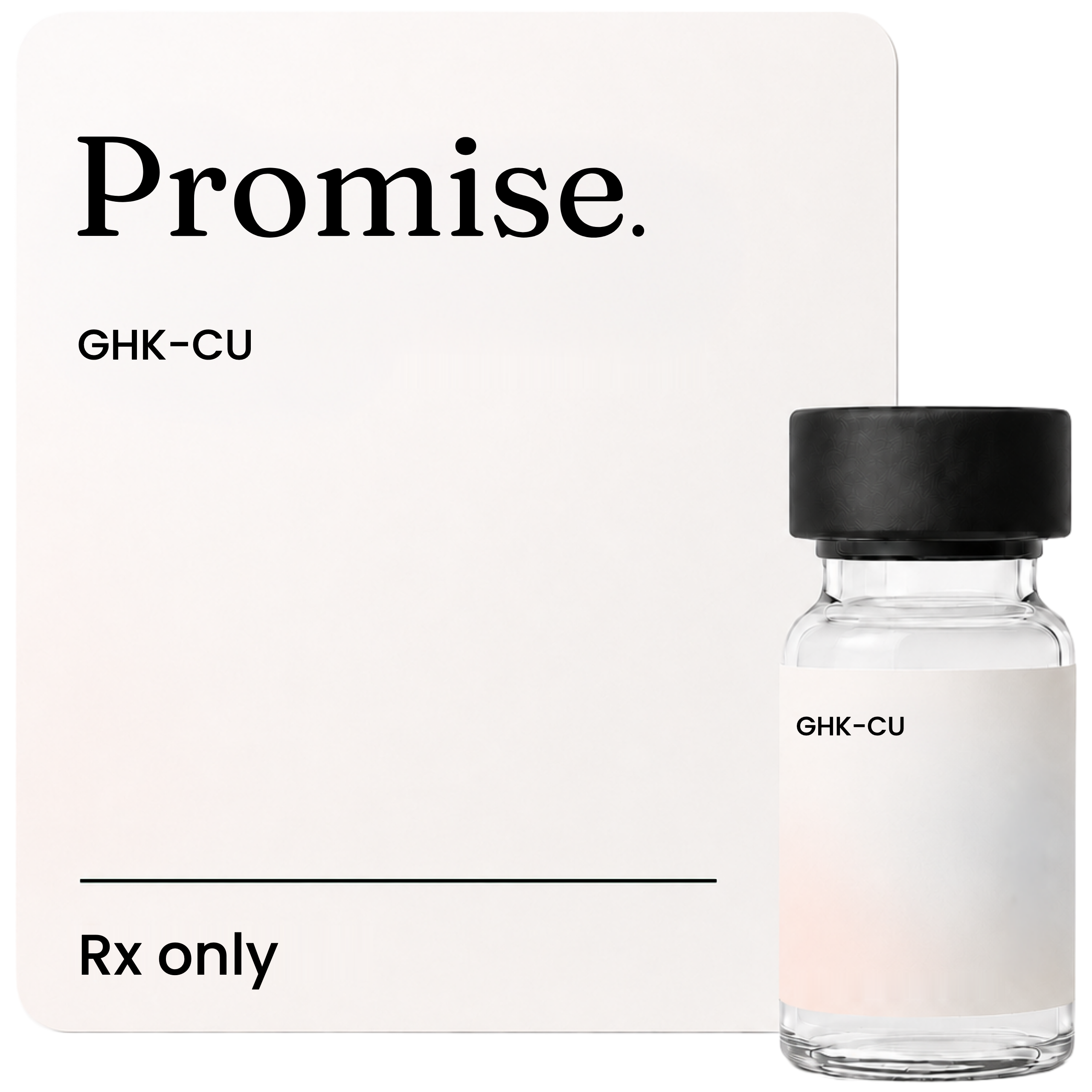
GHK-Cu vial and spec card
GHK-Cu · Rx only
1

Share your health history

GHK-Cu has its own online clinical questionnaire — your history, medications, and goals.

2

Your answers get a careful review

A clinician reads your history and takes the time to get it right before anything is prescribed.

3

Your pharmacy ships

Compounded for your prescription and shipped cold-chain, with care-team check-ins after.

The safe way to take GHK-Cu seriously

GHK-Cu is easy to find online and hard to trust there. Promise works the way medicine is supposed to work — a clinician decides, a licensed pharmacy fills, and someone stays accountable to you.

A real prescription

Prescribed for you specifically, after a real look at your health history — never pulled off a shelf.

A real pharmacy

Your prescription is compounded for you by a licensed U.S. pharmacy — not a mystery vial from an unregulated website.

Real oversight

Temperature-safe shipping, follow-up check-ins, and a care team that answers — before and after your medication arrives.

Product details
Form
Injectable vial (subcutaneous), 10 mg per mL
Supply
35-day supply
Pharmacy
Compounded by a licensed U.S. pharmacy
Availability
Ships to all 50 states + D.C.; not all treatments are available in every state

A copper carrier, not just a peptide

The three-amino-acid sequence binds copper with high affinity, and much of the research reads GHK-Cu as a way the body moves that copper to where enzymes can use it.

Occurs naturally, declines with age

GHK-Cu is found in human plasma and other fluids, and measured levels fall over the decades. That age-related decline is what drew longevity researchers to it.

Prescribed, never simply supplied

A licensed provider reads your history, decides whether GHK-Cu fits it, and sets the protocol.

In brief.

Copper is not something the body leaves lying around loose. It is carried, handed off, and delivered to the enzymes that need it, and GHK-Cu is one of the molecules that does the carrying. It is a naturally occurring tripeptide that binds a copper ion, circulates in human plasma, and is measured at lower and lower concentrations as a person gets older.

That age-related decline is what put it on the longevity shelf. Promise offers it one way only: a licensed provider reviews your health history and prescribes it only when treatment is appropriate for you.
What GHK-Cu is

GHK-Cu is three amino acids — glycine, L-histidine, and L-lysine — in a short chain, with a copper ion held in the middle. It was first isolated from human plasma decades ago, and it has since been found in saliva and urine as well. Nothing about it is exotic; the interest comes from the fact that levels fall with age and that copper is a cofactor for enzymes involved in building and maintaining connective tissue.

It belongs to our anti-aging and longevity category, and it is also one of the peptides in KLOW, our multi-peptide blend. Some people are prescribed GHK-Cu on its own; some are better served by the blend. That is a decision a clinician makes with you.

How it is studied to work

The research reads GHK-Cu two ways at once. The first is as a copper shuttle: the peptide binds copper tightly enough to carry it and loosely enough to release it, which makes it a plausible delivery mechanism for a metal the body needs but cannot allow to circulate freely. The second is as a signaling molecule in its own right. Laboratory work has looked at how it influences the expression of genes involved in extracellular-matrix remodeling — the scaffolding of collagen and elastin that holds skin and connective tissue together — and at fibroblast behavior, since fibroblasts are the cells that build that scaffolding.

The honest picture is that most of this evidence is in vitro or from topical formulations, where GHK-Cu has been studied for years in dermatology. Human data on a compounded injectable form is far thinner. Mechanism is not outcome, and a well-described pathway is not a promise about how any one person will respond.

Where GHK-Cu fits alongside KLOW

A single peptide and a blend answer different questions. Prescribing GHK-Cu on its own keeps the variable clean: one compound, one protocol, one thing to evaluate at your follow-up. KLOW folds GHK-Cu in with other peptides in a single vial, which suits someone whose provider wants to work on several fronts at once.

There is no ranking here. The blend is not a stronger version of the single compound, and the single compound is not a starter tier. What matters is which one your history supports, whether you have any copper-related considerations in your medical record, and what else you are already taking.

How GHK-Cu is prescribed

Everything starts with an intake questionnaire built specifically for this compound: your health history, current medications, and what you are trying to address. A licensed provider reads it. If GHK-Cu is a reasonable fit, they write the prescription and set the protocol. If it is not, they decline, and they will tell you why.

That gate is not paperwork. It is the difference between a prescribed treatment and something a person talks themselves into, and it means a real clinician has weighed a copper-containing peptide against the rest of your chart before anything ships.

What treatment looks like

If you are prescribed, your medication is compounded and dispensed by a licensed U.S. pharmacy, and shipped in discreet, temperature-safe packaging. Dosing is not a number to find online — your provider sets the protocol from your evaluation, and you follow theirs.

After that it is check-ins. Your care team follows up, and any change happens with a clinician involved. GHK-Cu is a support layered on top of the fundamentals — sleep, sun protection, nutrition, sane training — not a substitute for them. It exists to help you keep the promise you already made to yourself.

Common questions

What is GHK-Cu?

GHK-Cu is a tripeptide — glycyl-L-histidyl-L-lysine — bound to a copper ion. It occurs naturally in human plasma and other body fluids, and measured levels decline with age. Research interest centers on how it transports copper into cells and on its signaling role in skin remodeling and collagen synthesis. Much of that work is laboratory and topical research rather than large human trials of an injectable form, so the mechanism is better described than the outcomes.

Do I need a prescription for GHK-Cu?

Yes. GHK-Cu is available through Promise only by prescription. You complete an intake questionnaire, a licensed provider reviews your health history, and they prescribe only when treatment is appropriate for you.

Is GHK-Cu FDA-approved?

No. GHK-Cu is not FDA-approved. It is a compounded medication, and compounded medications are not reviewed by the FDA for safety, effectiveness, or quality. It is prepared by a licensed U.S. compounding pharmacy against a prescription written for you specifically, after a licensed provider has reviewed your health history.

How does the online visit work?

You start with the intake form for GHK-Cu, which is its own clinical questionnaire covering your health history, medications, and goals. A licensed provider reviews your answers and prescribes only if GHK-Cu is appropriate for you. If it is, your medication is compounded and dispensed by a licensed U.S. pharmacy and shipped in temperature-safe packaging, with follow-up check-ins from your care team.

How is GHK-Cu different from KLOW?

GHK-Cu on its own is a single peptide, dosed and adjusted on its own terms. KLOW is a blend, and GHK-Cu is one of the peptides in it, combined with others in a single compounded formulation. Which of the two makes sense depends on what you and your provider are trying to address and on what else you are taking; a single compound is easier to evaluate in isolation, while a blend covers more ground at once. That is a clinical decision.

Related treatments

Other Anti-Aging & Longevity options a provider may consider.