Mood & Libido · Rx only

Kisspeptin, prescribed — not just shipped.

Skip the gray-market guesswork. A licensed clinician reviews your health history, a licensed U.S. pharmacy compounds your prescription, and a care team stays with you after it ships.

$243 / mo$270 as a single month · $648 for a 3-month supply

A licensed clinician reviews every request. If Kisspeptin fits your health history, they write your prescription and your pharmacy takes it from there.

Licensed U.S. providers Licensed U.S. pharmacy All 50 states + D.C.

Requires an online medical evaluation. Prescribed only when a licensed provider determines it's appropriate.

A licensed clinician in a consultation room
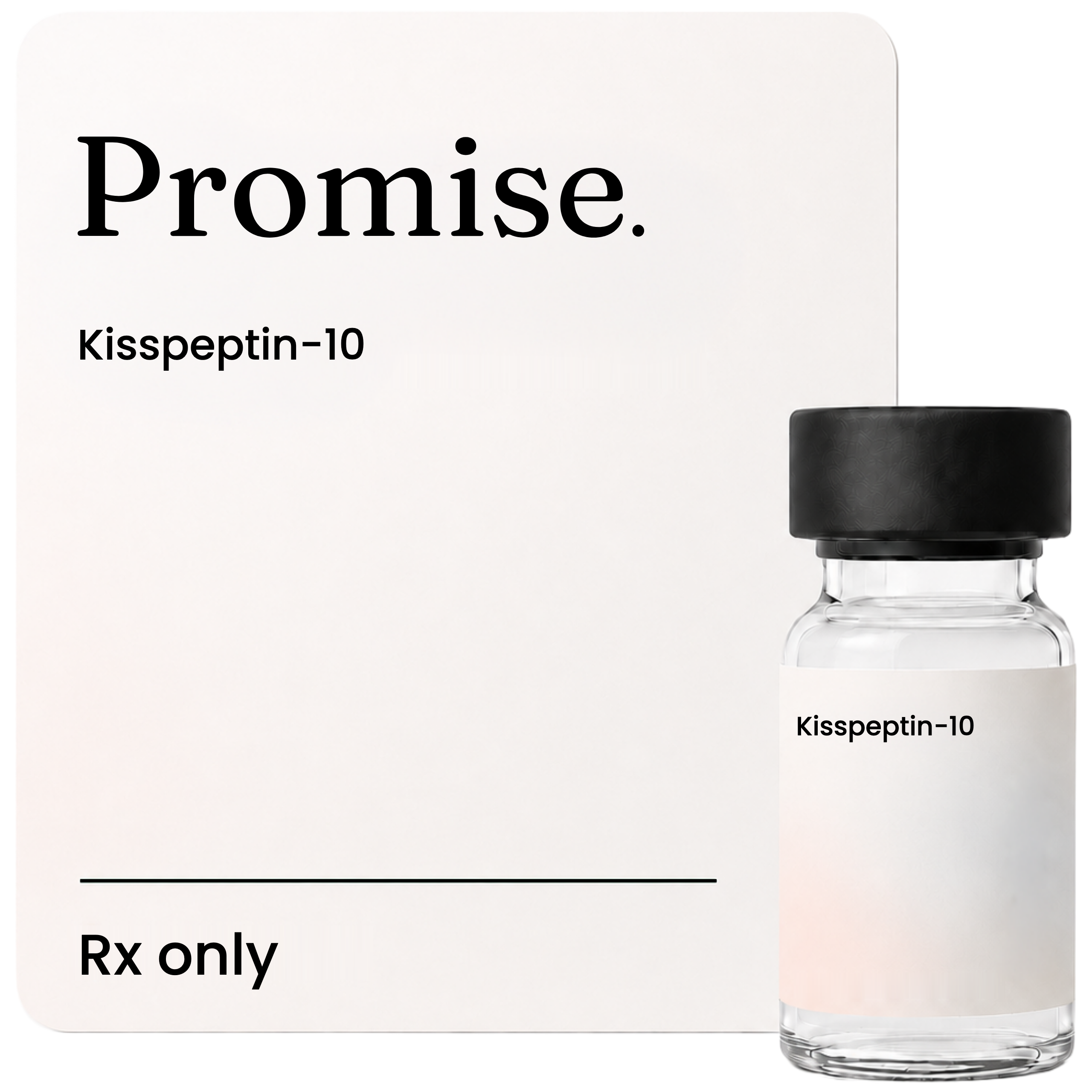
Kisspeptin vial and spec card
Kisspeptin · Rx only
1

Share your health history

Kisspeptin has its own online clinical questionnaire — your history, medications, and goals.

2

Your answers get a careful review

A clinician reads your history and takes the time to get it right before anything is prescribed.

3

Your pharmacy ships

Compounded for your prescription and shipped cold-chain, with care-team check-ins after.

The safe way to take Kisspeptin seriously

Kisspeptin is easy to find online and hard to trust there. Promise works the way medicine is supposed to work — a clinician decides, a licensed pharmacy fills, and someone stays accountable to you.

A real prescription

Prescribed for you specifically, after a real look at your health history — never pulled off a shelf.

A real pharmacy

Your prescription is compounded for you by a licensed U.S. pharmacy — not a mystery vial from an unregulated website.

Real oversight

Temperature-safe shipping, follow-up check-ins, and a care team that answers — before and after your medication arrives.

Product details
Form
Injectable vial (subcutaneous), 1 mg per mL
Supply
56-day supply
Pharmacy
Compounded by a licensed U.S. pharmacy
Availability
Ships to all 50 states + D.C.; not all treatments are available in every state

Signals the hypothalamus

Kisspeptin binds its own receptor on hypothalamic neurons and is studied for the release of GnRH, the first step in the reproductive hormone sequence.

Upstream, not replacement

The research question is whether an intact hormone axis can be prompted to signal — a different premise from supplying a hormone directly.

Prescribed after review

A licensed provider reads your history, often alongside labs, and decides whether kisspeptin fits it.

In brief.

Kisspeptin is the least intuitive compound in this category, because it does not act where most people would expect. It sits upstream — at the hypothalamic switch that starts the reproductive hormone cascade, several steps before any hormone is released.

It is a neuropeptide, and Promise offers it one way only: a licensed provider reviews your health history and prescribes it only when treatment is appropriate for you.
What kisspeptin is

Kisspeptin is the product of the KISS1 gene, first identified by a research group in Hershey, Pennsylvania, which is genuinely where the name comes from. It went from curiosity to central importance when investigators found that people carrying loss-of-function mutations in its receptor never enter puberty. That single observation put kisspeptin at the top of the reproductive endocrine hierarchy.

The form used clinically is usually kisspeptin-10, a ten-amino-acid fragment of the natural peptide that binds the same receptor. It is studied as a signal rather than as a hormone replacement. It tells an existing system to fire; it does not stand in for the hormones that system produces.

Upstream of the hormone axis

The hypothalamic-pituitary-gonadal axis runs in sequence. Kisspeptin neurons in the hypothalamus signal the GnRH-producing neurons; GnRH prompts the pituitary to release LH and FSH; those act in turn on the testes or the ovaries. Kisspeptin sits at the first link, which is why research interest in it spans puberty, fertility, and reproductive hormone signaling generally.

That position is also what makes it different in kind from any direct replacement. The research question with kisspeptin is whether an intact axis can be prompted to signal, not whether a missing hormone can be supplied. Whether your axis is intact is exactly the sort of thing a provider looks at, often with labs, before deciding anything at all.

Kisspeptin and PT-141 are not the same idea

Both compounds turn up in mood and libido conversations, and they get confused constantly. PT-141 is a melanocortin receptor agonist studied in central circuits associated with desire; it does not touch the hormone axis. Kisspeptin works the other way around, as an upstream hormonal signal, and separate imaging research has examined whether administering it influences limbic processing of attraction and arousal cues.

So the two are studied for related territory by different routes. A provider choosing between them is not ranking one above the other. They are deciding which mechanism, if either, matches what your history and your labs actually suggest.

Where the evidence stands

Most human work on kisspeptin comes from academic infusion studies — small groups, controlled settings, short exposures, measuring hormone response and brain activity rather than long-term outcomes. It is a well-characterized signaling molecule with a thin clinical file, and those two facts sit together uncomfortably.

Kisspeptin is not FDA-approved, and the compounded form prescribed here has not been reviewed by the FDA for safety, effectiveness, or quality. We would rather state that plainly than dress it up. The research is interesting and early, which is an argument for a clinician in the loop rather than an argument for silence.

How it is prescribed, and what follows

Everything begins with the intake questionnaire built for kisspeptin. It is its own clinical form — your health history, current medications, relevant labs, and what you are trying to address. A licensed provider reads it and decides. If kisspeptin is a reasonable fit, they write the prescription and set the protocol; if it is not, they decline and say so.

If you are prescribed, your medication is compounded and dispensed by a licensed U.S. pharmacy, and shipped in discreet, temperature-safe packaging. Your care team follows up, and anything that needs to change, changes with a clinician involved rather than on your own read of a message board.

Common questions

What is kisspeptin?

Kisspeptin is a neuropeptide encoded by the KISS1 gene and produced by neurons in the hypothalamus. It binds its own receptor on the neurons that release GnRH, which sits at the top of the hypothalamic-pituitary-gonadal axis. The form used clinically is usually kisspeptin-10, a ten-amino-acid fragment of the natural peptide that binds the same receptor. It is studied as an upstream signal rather than as a hormone in its own right.

How is kisspeptin different from PT-141?

They approach related territory by different routes. PT-141 is a melanocortin receptor agonist studied in central brain circuits associated with sexual desire, and it does not act on the hormone axis at all. Kisspeptin is an upstream hormonal signal, and separate imaging research has looked at whether administering it influences how the brain processes attraction and arousal cues. A provider choosing between them is not picking a stronger or weaker option; they are deciding which mechanism, if either, matches your history and labs.

Is kisspeptin FDA-approved?

No. Kisspeptin is not FDA-approved. It is a compounded medication, and compounded medications are not reviewed by the FDA for safety, effectiveness, or quality. It is prepared by a licensed U.S. compounding pharmacy against a prescription written for you specifically, after a licensed provider has reviewed your health history.

What does the human research on kisspeptin look like?

Most of it comes from academic infusion studies: small groups, controlled settings, short exposures, measuring hormone response and brain activity rather than long-term outcomes. Kisspeptin is unusually well characterized as a signaling molecule, largely because researchers found that people with loss-of-function mutations in its receptor do not enter puberty, but its clinical file is thin. The evidence is early, and that is a reason for a clinician to be involved rather than a reason to avoid the subject.

Do I need a prescription, and how does the visit work?

Yes. You complete the intake questionnaire built for kisspeptin, which is its own clinical form covering your health history, medications, and what you are trying to address. A licensed provider reviews your answers, may ask for labs given where this compound acts, and prescribes only when kisspeptin is appropriate for you. If you are prescribed, a licensed U.S. pharmacy compounds and dispenses your medication and ships it in temperature-safe packaging, with follow-up check-ins from your care team.

Related treatments

Other Mood & Libido options a provider may consider.