Metabolic Support & Fat Loss · Rx only

Semaglutide, prescribed — not just shipped.

Skip the gray-market guesswork. A licensed clinician reviews your health history, a licensed U.S. pharmacy compounds your prescription, and a care team stays with you after it ships.

$220.50 / mo$245 as a single month · $588 per quarter

A licensed clinician reviews every request. If Semaglutide fits your health history, they write your prescription and your pharmacy takes it from there.

Licensed U.S. providers Licensed U.S. pharmacy All 50 states + D.C.

Requires an online medical evaluation. Prescribed only when a licensed provider determines it's appropriate.

A licensed clinician in a consultation room
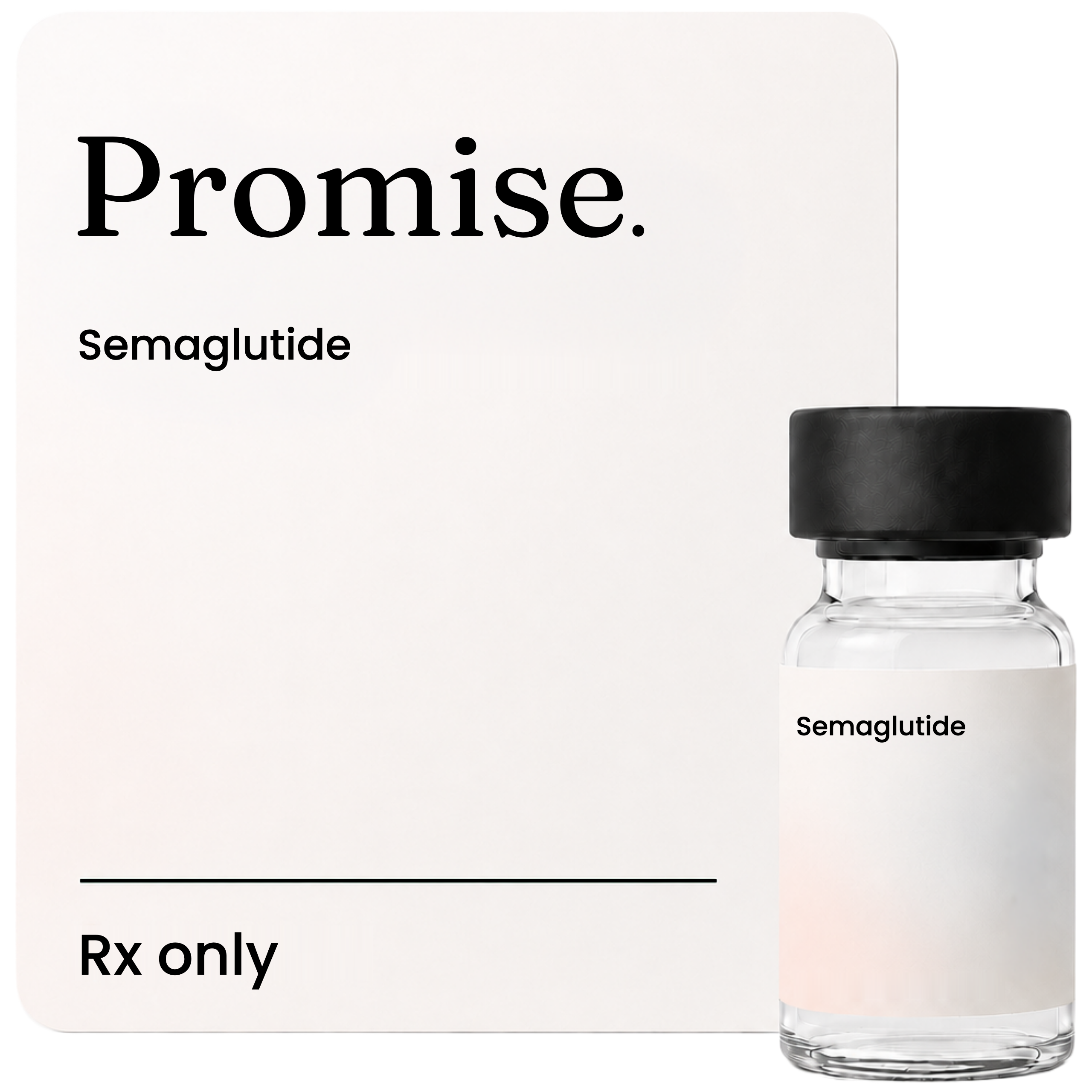
Semaglutide vial beside a Promise product card
Semaglutide · Rx only
1

Share your health history

Semaglutide has its own online clinical questionnaire — your history, medications, and goals.

2

Your answers get a careful review

A clinician reads your history and takes the time to get it right before anything is prescribed.

3

Your pharmacy ships

Compounded for your prescription and shipped cold-chain, with care-team check-ins after.

The safe way to take Semaglutide seriously

Semaglutide is easy to find online and hard to trust there. Promise works the way medicine is supposed to work — a clinician decides, a licensed pharmacy fills, and someone stays accountable to you.

A real prescription

Prescribed for you specifically, after a real look at your health history — never pulled off a shelf.

A real pharmacy

Your prescription is compounded for you by a licensed U.S. pharmacy — not a mystery vial from an unregulated website.

Real oversight

Temperature-safe shipping, follow-up check-ins, and a care team that answers — before and after your medication arrives.

Product details
Form
Injectable vial (subcutaneous), compounded with vitamin B12
Supply
30-day supply
Pharmacy
Compounded by a licensed U.S. pharmacy
Availability
Ships to all 50 states + D.C.; not all treatments are available in every state

Studied for appetite signaling

Semaglutide is a GLP-1 receptor agonist: the pathways under study are satiety signaling, how quickly the stomach empties, and glucose-dependent insulin release.

A licensed provider decides

Every request is reviewed by a clinician, who prescribes only when treatment is appropriate.

Protocol set for you, then followed up

Your provider decides how treatment begins and how it changes over time, and follow-up check-ins are included so the plan can be adjusted.

In brief.

Semaglutide is a GLP-1 receptor agonist, compounded with vitamin B12 and prescribed for weight management alongside diet and exercise. It acts on appetite signals the gut and the brain already use, which is what makes it a medical treatment rather than a supplement. A licensed provider reviews every request and prescribes only when treatment is appropriate for you.

What Semaglutide is

GLP-1 is a hormone the small intestine releases after you eat. It is involved in telling the brain you have had enough, in how quickly the stomach empties, and in how the pancreas responds to arriving glucose. Semaglutide is a long-acting analog of that hormone — close enough to bind the same receptors, built to stay in circulation far longer than the natural version, which is cleared in minutes. Promise dispenses it as a compounded formulation that also contains vitamin B12.

Semaglutide has been studied more heavily than most of what gets discussed in this category, and it is worth being precise about what that means. That research was done on manufactured, approved products, and a compounded formulation is different from an FDA-approved one: what Promise dispenses is prepared by a licensed U.S. pharmacy and is not FDA-approved. The molecule is well characterized; the preparation is a pharmacy's; a provider's judgment is what stands between the two and you.

How it works in the body

Semaglutide acts at GLP-1 receptors in several places at once. In the hypothalamus, those receptors sit on the circuits that register fullness. In the stomach, GLP-1 signaling slows the rate at which a meal moves through. In the pancreas, it supports glucose-dependent insulin release, meaning the response tracks blood sugar rather than pushing insulin regardless of it.

Taken together, the pathways under study are appetite, satiety, and glucose handling — not metabolism being sped up. That distinction is useful when you are deciding whether this is the right kind of treatment for what you are actually trying to change.

The vitamin B12 in the compounded formulation is a common addition in compounded GLP-1 preparations. It is not what drives the medication's activity, which happens at the GLP-1 receptor, and your provider can explain how the pharmacy's preparation fits your protocol.

How it is prescribed

The intake form for Semaglutide is its own clinical questionnaire: weight history, medical history, the personal and family history that matters for this class of medication, everything you currently take, and what you are trying to achieve. It is longer than most, and that is deliberate.

A licensed provider reviews it and prescribes only when treatment is appropriate for you. Certain histories rule this class out entirely, and requests are declined — catching that is what the review is for.

What treatment looks like

If you are prescribed, a licensed U.S. pharmacy compounds and dispenses your medication and ships it in temperature-safe packaging. Your provider sets the protocol, including how treatment begins and how it changes over time; Promise does not publish dosing, because it is not one thing for everyone. Follow-up check-ins are part of the plan.

The medication supports the work rather than replacing it. Protein, resistance training, sleep, and eating patterns are what it is meant to run alongside, and providers keep raising them because a change in appetite is an opening rather than an endpoint. If you are weighing the two options, Tirzepatide is the dual-receptor medication in the same metabolic support and fat loss category — which one, if either, is a conversation with your provider.

Common questions

What is Semaglutide?

Semaglutide is a GLP-1 receptor agonist: a long-acting analog of GLP-1, the hormone the gut releases after eating that is involved in fullness, in how quickly the stomach empties, and in insulin response. It is prescribed for weight management alongside diet and exercise. Promise dispenses it as a compounded formulation with vitamin B12, available only after a licensed provider reviews your health history.

Do I need a prescription for Semaglutide?

Yes. Semaglutide is prescription-only. You complete the intake form written for this product, a licensed provider reviews your health history and medications, and it is prescribed only when the provider determines it is appropriate for you.

Is Semaglutide FDA-approved?

No — not the version Promise dispenses. Semaglutide exists in FDA-approved products, but not the compounded formulation offered here, which is prepared with vitamin B12 by a licensed U.S. pharmacy and is not FDA-approved. Compounded medications are not reviewed by the FDA for safety, effectiveness, or quality, which is part of why a licensed provider reviews your health history and prescribes only when treatment is appropriate for you.

How does the online visit work?

You complete the Semaglutide intake form online: weight and medical history, the personal and family history relevant to this class of medication, current medications, and your goals. A licensed provider reviews it and either prescribes, asks for more information, or declines if treatment is not appropriate for you. If it is prescribed, a licensed U.S. pharmacy compounds and ships your medication, and follow-up check-ins are part of the plan.

Why is vitamin B12 in the compounded formulation?

The semaglutide Promise dispenses is compounded with vitamin B12, a common addition in compounded GLP-1 preparations made by U.S. pharmacies. The B12 is not what drives the medication's activity — semaglutide acts at GLP-1 receptors — and it is part of the pharmacy's preparation rather than something you add or adjust yourself. Your provider can explain how it fits the protocol they set for you.

Related treatments

Other Metabolic Support & Fat Loss options a provider may consider.