Hormone & Organ Health · Rx only

Tesamorelin, prescribed — not just shipped.

Skip the gray-market guesswork. A licensed clinician reviews your health history, a licensed U.S. pharmacy compounds your prescription, and a care team stays with you after it ships.

$243 / mo$270 as a single month · $648 per quarter

A licensed clinician reviews every request. If Tesamorelin fits your health history, they write your prescription and your pharmacy takes it from there.

Licensed U.S. providers Licensed U.S. pharmacy All 50 states + D.C.

Requires an online medical evaluation. Prescribed only when a licensed provider determines it's appropriate.

A licensed clinician in a consultation room
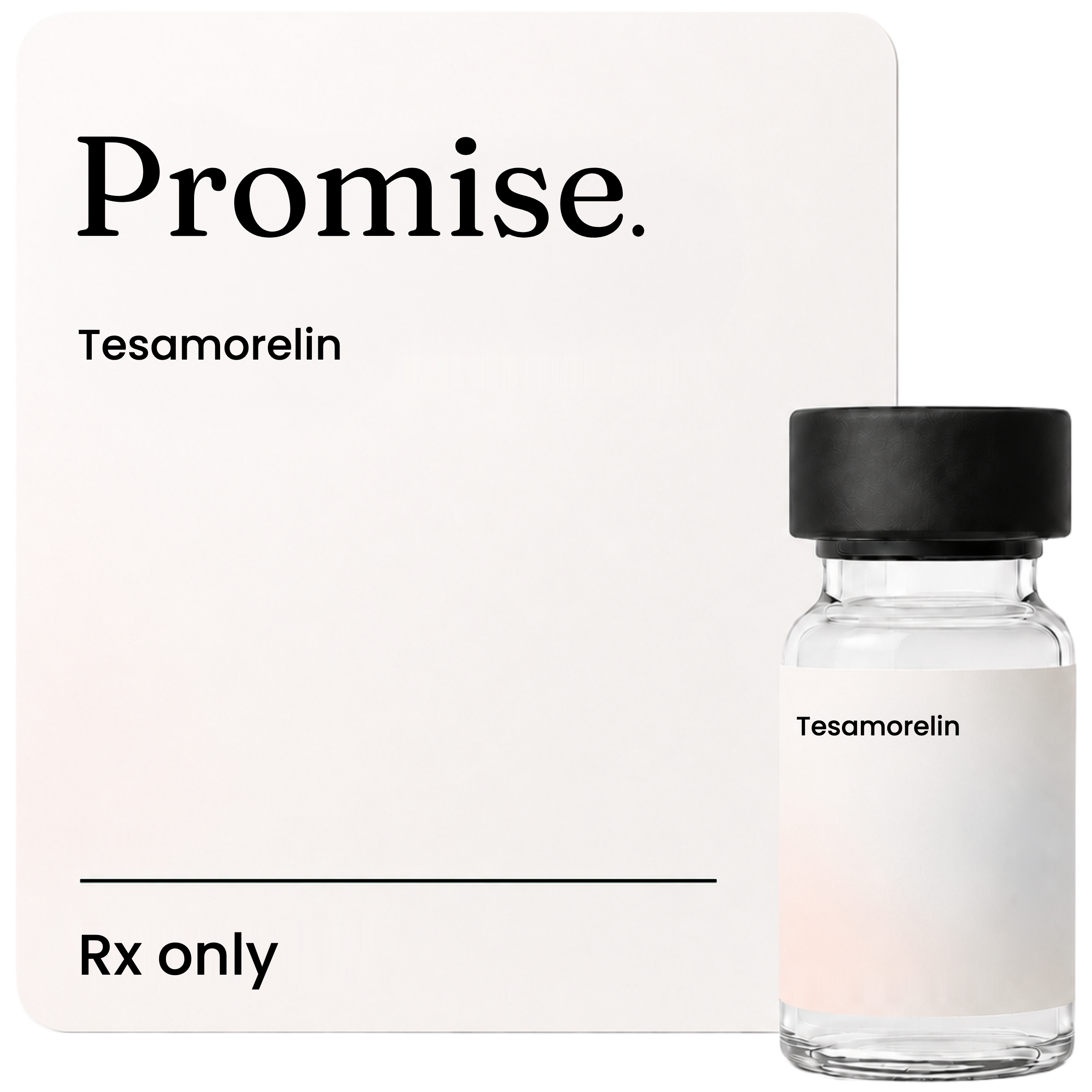
Tesamorelin vial and spec card
Tesamorelin · Rx only
1

Share your health history

Tesamorelin has its own online clinical questionnaire — your history, medications, and goals.

2

Your answers get a careful review

A clinician reads your history and takes the time to get it right before anything is prescribed.

3

Your pharmacy ships

Compounded for your prescription and shipped cold-chain, with care-team check-ins after.

The safe way to take Tesamorelin seriously

Tesamorelin is easy to find online and hard to trust there. Promise works the way medicine is supposed to work — a clinician decides, a licensed pharmacy fills, and someone stays accountable to you.

A real prescription

Prescribed for you specifically, after a real look at your health history — never pulled off a shelf.

A real pharmacy

Your prescription is compounded for you by a licensed U.S. pharmacy — not a mystery vial from an unregulated website.

Real oversight

Temperature-safe shipping, follow-up check-ins, and a care team that answers — before and after your medication arrives.

Product details
Form
Injectable vial (subcutaneous), 3 mg per mL
Supply
35-day supply
Pharmacy
Compounded by a licensed U.S. pharmacy
Availability
Ships to all 50 states + D.C.; not all treatments are available in every state

A stabilized GHRH analog

It keeps the full growth-hormone-releasing hormone sequence and shields the point where blood enzymes would otherwise cut it apart within minutes.

The deepest research record in this group

Tesamorelin has been examined in large placebo-controlled randomized trials, with visceral adipose tissue measured by CT imaging — a level of study peptides in this category rarely reach.

Prescribed after a clinical review

A licensed provider reads your history, may request lab work, and prescribes only when tesamorelin is appropriate for you.

In brief.

Tesamorelin is a synthetic analog of growth-hormone-releasing hormone, stabilized so it survives long enough in circulation to do its signaling work. Like the rest of this group, it does not supply growth hormone. It is studied for prompting the pituitary gland to release the body's own.

What sets it apart is the evidence behind it. Tesamorelin has been through large randomized human trials, which is unusual for a peptide in this category — and it is the reason a provider may consider it before the others. Promise offers it one way only: a licensed provider reviews your health history and prescribes it only when treatment is appropriate for you.
What tesamorelin is

Natural growth-hormone-releasing hormone is a 44-amino-acid peptide with a short working life; enzymes in the blood take it apart within minutes. Tesamorelin keeps that full-length sequence and adds a small fatty-acid group at one end, which shields the point where those enzymes cut. The result is the same message to the pituitary, delivered in a molecule that lasts long enough to be given as a once-daily injection.

That design places it in the same family as Sermorelin and the GHRH half of our CJC-1295 / Ipamorelin blend. All three speak to the same receptor. They differ in how they are built, how long they persist, and — most of all — in how much clinical study stands behind them.

Where the research comes from

Most of the human data on tesamorelin comes from multi-centre randomized trials in people with HIV-associated lipodystrophy, a condition marked by an accumulation of visceral adipose tissue — the deep fat around the organs, distinct from the fat directly under the skin. Those trials measured visceral fat by CT imaging alongside IGF-1 and lipid markers, and they ran with placebo controls at a scale peptides in this space almost never reach.

Two honest caveats belong next to that. The trials studied a specific population with a specific problem, so they describe what was observed there rather than what happens in a healthy adult using it for body composition or recovery. And the effects reported in that literature tracked with continued treatment. None of this predicts an individual result, which is why the decision runs through a clinician rather than a product page.

How it acts on the growth hormone axis

Tesamorelin binds GHRH receptors on the somatotroph cells of the anterior pituitary, the cells that manufacture growth hormone. Stimulating them prompts release in the body's own pulsatile pattern — largest during deep sleep — and growth hormone in turn signals the liver to produce IGF-1, which carries much of the downstream activity researchers actually measure.

Because the signal enters upstream, the pituitary's regulation stays in the circuit, including somatostatin, the brake that limits how much is released. That is the structural difference from administering growth hormone itself, which bypasses that regulation. It is also why providers watch IGF-1: it is the readable marker of what the axis is doing.

How it is prescribed

You begin with the intake questionnaire written for tesamorelin — a clinical form specific to this compound, not a generic sign-up. It asks about your health history, current medications and supplements, symptoms, and what you want treatment to address. A licensed provider reviews your answers and may ask for lab work before deciding.

A history of cancer, certain pituitary conditions, pregnancy, and some interacting medications all weigh on that decision. Not everyone qualifies, and the review is doing its job when it says no.

What treatment looks like

If you are prescribed, a licensed U.S. pharmacy compounds and dispenses your medication and ships it in temperature-safe packaging. Your provider sets the protocol, including timing, because release patterns follow your sleep more closely than a schedule of convenience. Promise does not publish dosing.

Follow-up check-ins come with the plan, and they are where the protocol gets adjusted, paused, or stopped. Tesamorelin sits alongside the things that move the same system anyway — sleep, training, nutrition, alcohol — rather than replacing them. If you want to see how it compares with the other options in the category, the hormone and organ health hub lays them out, and the Tesamorelin / Ipamorelin blend pairs this peptide with a secretagogue that acts on a second receptor.

Common questions

What is Tesamorelin?

Tesamorelin is a synthetic analog of growth-hormone-releasing hormone. It keeps the full 44-amino-acid sequence of the natural signal and adds a small fatty-acid group at one end, which shields the molecule from the enzymes that would otherwise clear it within minutes. It does not supply growth hormone; it is studied for prompting the pituitary gland to release the body's own, in the pulsatile pattern the gland already uses.

What has tesamorelin been studied for?

Its human research record comes mainly from multi-centre randomized, placebo-controlled trials in people with HIV-associated lipodystrophy, where visceral adipose tissue — the deep fat around the organs — was measured by CT imaging alongside IGF-1 and lipid markers. That is a specific population with a specific problem, so the findings describe what was observed there rather than what happens in a healthy adult. It remains the most clinically examined compound in this group.

Do I need a prescription, and how does the online visit work?

Yes, tesamorelin is prescription-only. You complete the intake questionnaire written for this compound, covering your health history, medications, symptoms, and goals. A licensed provider reviews it, may ask for lab work, and prescribes only when treatment is appropriate for you. If it is prescribed, a licensed U.S. pharmacy compounds and ships your medication in temperature-safe packaging, with follow-up check-ins from your care team.
Is Tesamorelin FDA-approved?

No. The tesamorelin Promise offers is a compounded medication and is not FDA-approved. Compounded medications are prepared by a licensed U.S. pharmacy against a prescription written for one individual, and they are not reviewed by the FDA for safety, effectiveness, or quality.

How is Tesamorelin different from Sermorelin or the CJC-1295 blend?

All of them speak to the same receptor on the pituitary. Sermorelin copies the active 29-amino-acid fragment of growth-hormone-releasing hormone and clears quickly. CJC-1295 is that same fragment modified to resist breakdown, and is usually paired with a secretagogue. Tesamorelin keeps the full-length sequence with a stabilizing group attached, and carries by far the largest body of human trial data of the three. Which one suits your history is a clinical judgement your provider makes, not a ranking.

Related treatments

Other Hormone & Organ Health options a provider may consider.