Hormone & Organ Health · Rx only

Tesamorelin / Ipamorelin, prescribed properly.

Skip the gray-market guesswork. A licensed clinician reviews your health history, a licensed U.S. pharmacy compounds your prescription, and a care team stays with you after it ships.

$256.50 / mo$285 as a single month · $684 per quarter

A licensed clinician reviews every request. If Tesamorelin / Ipamorelin fits your health history, they write your prescription and your pharmacy takes it from there.

Licensed U.S. providers Licensed U.S. pharmacy All 50 states + D.C.

Requires an online medical evaluation. Prescribed only when a licensed provider determines it's appropriate.

A licensed clinician in a consultation room
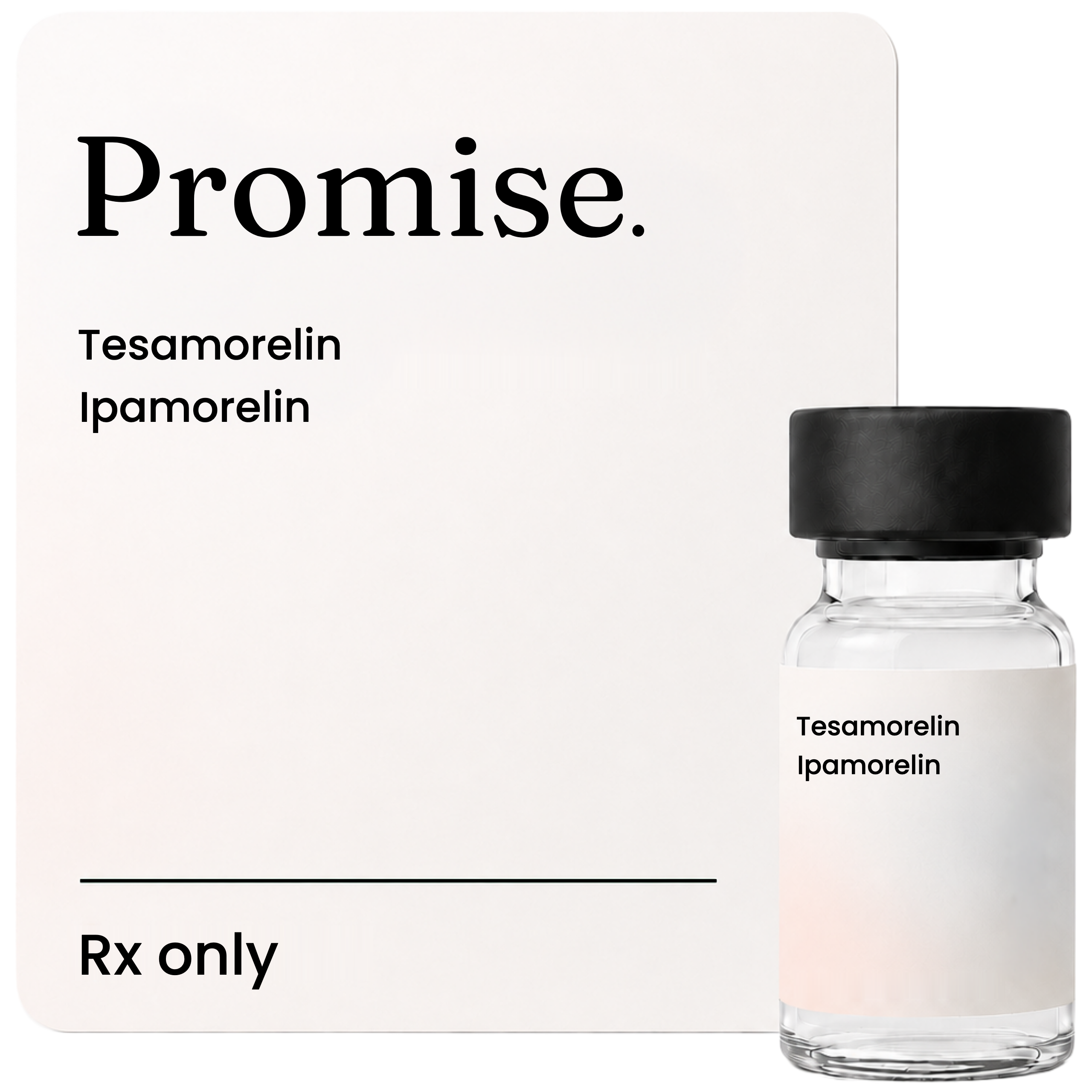
Tesamorelin / Ipamorelin vial and spec card
Tesamorelin / Ipamorelin · Rx only
1

Share your health history

Tesamorelin / Ipamorelin has its own online clinical questionnaire — your history, medications, and goals.

2

Your answers get a careful review

A clinician reads your history and takes the time to get it right before anything is prescribed.

3

Your pharmacy ships

Compounded for your prescription and shipped cold-chain, with care-team check-ins after.

The safe way to take Tesamorelin / Ipamorelin seriously

Tesamorelin / Ipamorelin is easy to find online and hard to trust there. Promise works the way medicine is supposed to work — a clinician decides, a licensed pharmacy fills, and someone stays accountable to you.

A real prescription

Prescribed for you specifically, after a real look at your health history — never pulled off a shelf.

A real pharmacy

Your prescription is compounded for you by a licensed U.S. pharmacy — not a mystery vial from an unregulated website.

Real oversight

Temperature-safe shipping, follow-up check-ins, and a care team that answers — before and after your medication arrives.

Product details
Form
Injectable vial (subcutaneous), 3 mg / 2 mg per mL
Supply
35-day supply
Pharmacy
Compounded by a licensed U.S. pharmacy
Availability
Ships to all 50 states + D.C.; not all treatments are available in every state

Two receptors, one pituitary cell

Tesamorelin acts on the GHRH receptor while ipamorelin acts on the ghrelin receptor, which is the mechanistic reason a GHRH analog and a secretagogue are studied as a pair.

The difference from the CJC-1295 blend

Same secretagogue, different GHRH analog. Tesamorelin is the full-length stabilized version and carries a much larger human trial record than the modified fragment CJC-1295 uses.

Prescribed after a clinical review

A licensed provider reads your history, may ask for lab work, and prescribes only when this blend is appropriate for you.

In brief.

This blend pairs tesamorelin, a stabilized analog of growth-hormone-releasing hormone, with ipamorelin, a selective growth hormone secretagogue. The two act on different receptors on the same pituitary cells. Neither supplies growth hormone — both are studied for prompting the body to release its own.

If you have looked at our CJC-1295 / Ipamorelin blend, this one will look similar on the label and is not the same thing underneath. The section below is the honest comparison. Promise offers both one way only: a licensed provider reviews your health history and prescribes only when treatment is appropriate for you.
What is in the vial

Tesamorelin keeps the full 44-amino-acid sequence of growth-hormone-releasing hormone and adds a small fatty-acid group that shields the molecule from the enzymes that would otherwise clear it within minutes. It binds GHRH receptors on the somatotroph cells of the anterior pituitary — the cells that manufacture growth hormone — and prompts release in the pulsatile pattern the gland already runs on.

Ipamorelin is a five-amino-acid secretagogue that binds the ghrelin receptor rather than the GHRH receptor. Published work describes it as selective: it moved growth hormone with comparatively little movement in cortisol and prolactin, which was the practical drawback of the earlier secretagogues it followed. It is also studied for easing somatostatin, the body's own brake on release.

How this differs from CJC-1295 / Ipamorelin

The secretagogue half is identical. Both blends use ipamorelin, at the same strength, doing the same job on the same receptor. Everything that separates the two sits in the GHRH analog paired with it.

CJC-1295 is a modified fragment — the active first 29 amino acids of the hormone, with substitutions that slow its breakdown. Tesamorelin is the full-length sequence, stabilized differently, and it carries a far larger body of human trial data behind it, including randomized placebo-controlled studies that measured visceral adipose tissue by CT imaging. That evidence gap is the real distinction between the two blends, not a claim about what either will do for you. The vials also differ in practice: this one is dispensed as a 35-day supply at 3 mg / 2 mg per mL, the CJC blend as a 28-day supply at 1.2 mg / 2 mg per mL.

Why a GHRH analog is paired with a secretagogue

Growth hormone release is governed by two opposing signals — GHRH pushing, somatostatin holding back — and the ghrelin receptor sits on a third pathway that research links to both. Pairing an analog of the pushing signal with a compound studied for easing the brake is the mechanistic argument for these blends, and the reason they are studied for a larger pulse than either peptide alone.

The pairing does not override the system. Release still runs through your own pituitary, so the feedback controls that limit growth hormone stay in the circuit. That is the structural difference between a secretagogue approach and supplying growth hormone from outside, and it applies to everything in hormone and organ health that works this way.

How it is prescribed

You start with the intake questionnaire written for this specific blend — your health history, current medications and supplements, symptoms, and what you want treatment to address. A licensed provider reads it, may request lab work such as IGF-1 before deciding, and prescribes only when this blend is appropriate for you.

A history of cancer, certain pituitary conditions, pregnancy, and some interacting medications all weigh on that decision. Not everyone qualifies — a provider may also decide that a single peptide, or nothing at all, is the better answer for your history.

What treatment looks like

If you are prescribed, a licensed U.S. pharmacy compounds and dispenses your medication and ships it in temperature-safe packaging. Your provider sets the protocol, timing included, because growth hormone release follows your sleep closely enough that when a dose lands is part of the clinical decision. Promise does not publish dosing.

Follow-up check-ins are part of the plan, so the protocol is adjusted with a clinician involved rather than left to run on its own. Sleep, training, protein, and alcohol still move this system as much as anything in the vial does. Treatment is there to support the promise you already made to yourself — not to stand in for it.

Common questions

What is Tesamorelin / Ipamorelin?

It is a compounded blend of two peptides that act on the growth hormone axis from different directions. Tesamorelin is a stabilized full-length analog of growth-hormone-releasing hormone and binds the GHRH receptor on the pituitary. Ipamorelin is a five-amino-acid secretagogue that binds the ghrelin receptor and is studied for easing somatostatin, the body's brake on release. Neither supplies growth hormone; both are studied for prompting the pituitary to release the body's own.

How is this different from CJC-1295 / Ipamorelin?

The secretagogue half is the same: ipamorelin, at the same strength, on the same receptor. The GHRH analog paired with it is what changes. CJC-1295 is a modified 29-amino-acid fragment of the hormone; tesamorelin keeps the full-length sequence with a stabilizing group attached and has been examined in large randomized, placebo-controlled human trials, which is a depth of study the fragment does not have. The vials differ too — this blend is a 35-day supply at 3 mg / 2 mg per mL, the CJC blend a 28-day supply at 1.2 mg / 2 mg per mL. Which one fits your history is your provider's judgement.

Do I need a prescription, and how does the online visit work?

Yes, this blend is prescription-only. You complete the intake questionnaire written for it — its own clinical form, covering your health history, medications, symptoms, and goals. A licensed provider reviews your answers, may request lab work such as IGF-1, and prescribes only when treatment is appropriate for you. If it is prescribed, a licensed U.S. pharmacy compounds and ships your medication in temperature-safe packaging, with follow-up check-ins from your care team.
Is Tesamorelin / Ipamorelin FDA-approved?

No. This blend is a compounded medication and is not FDA-approved. Compounded medications are prepared by a licensed U.S. pharmacy against a prescription written for one individual, and they are not reviewed by the FDA for safety, effectiveness, or quality.

Would a single peptide be better than a blend?

Sometimes, and that is a clinical question rather than a marketing one. Tesamorelin on its own has the clearest research record of anything in this category, and a provider may prefer it for that reason. A blend is studied for a larger pulse because it engages a second receptor, but more compounds also means more variables when something needs adjusting. Your provider weighs your history, your labs, and what you are trying to address before choosing.

Related treatments

Other Hormone & Organ Health options a provider may consider.