Anti-Aging & Longevity · Rx only

Epithalon, prescribed — not just shipped.

Skip the gray-market guesswork. A licensed clinician reviews your health history, a licensed U.S. pharmacy compounds your prescription, and a care team stays with you after it ships.

$270 One-time purchase — not a recurring plan

A licensed clinician reviews every request. If Epithalon fits your health history, they write your prescription and your pharmacy takes it from there.

Licensed U.S. providers Licensed U.S. pharmacy All 50 states + D.C.

Requires an online medical evaluation. Prescribed only when a licensed provider determines it's appropriate.

A licensed clinician in a consultation room
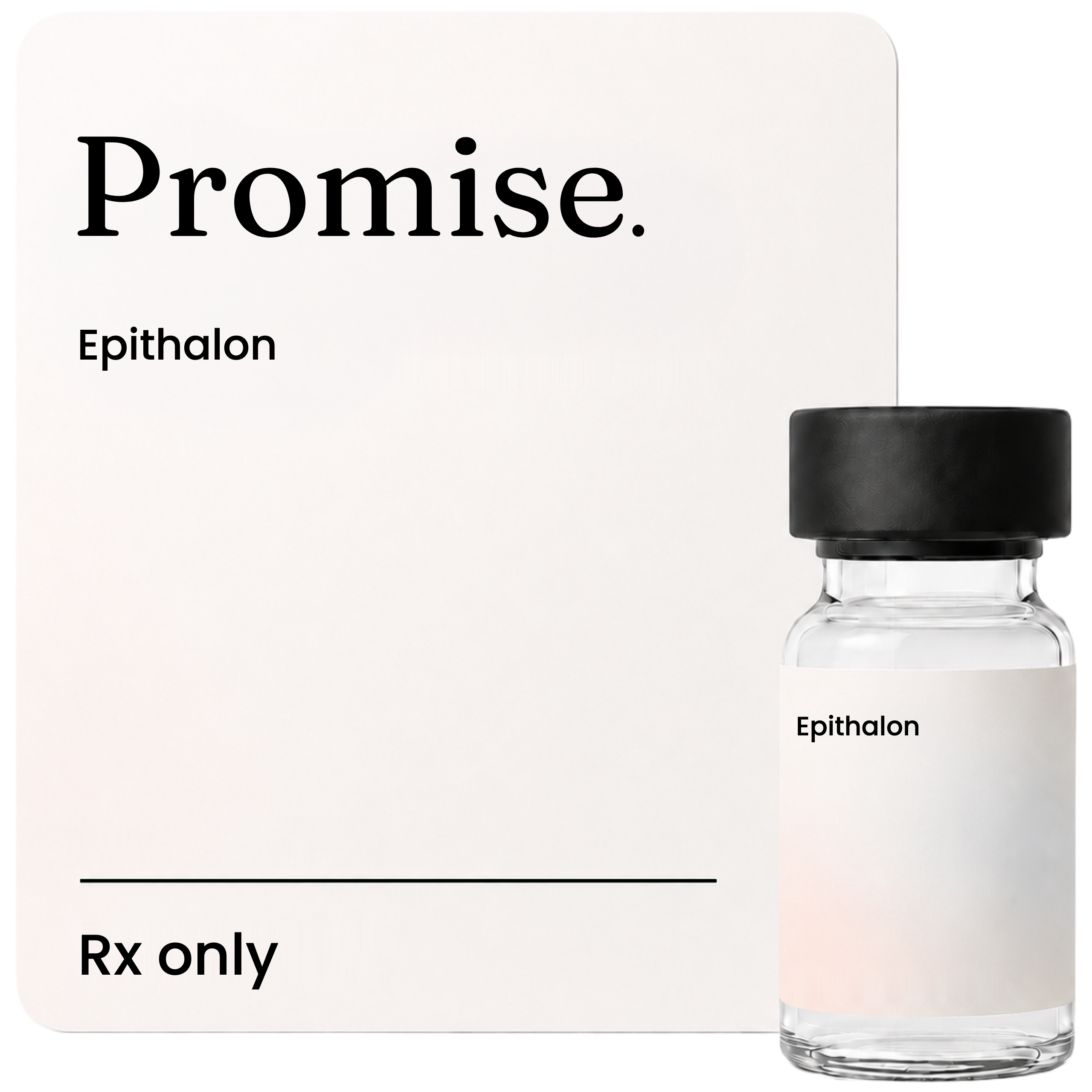
Epithalon vial and spec card
Epithalon · Rx only
1

Share your health history

Epithalon has its own online clinical questionnaire — your history, medications, and goals.

2

Your answers get a careful review

A clinician reads your history and takes the time to get it right before anything is prescribed.

3

Your pharmacy ships

Compounded for your prescription and shipped cold-chain, with care-team check-ins after.

The safe way to take Epithalon seriously

Epithalon is easy to find online and hard to trust there. Promise works the way medicine is supposed to work — a clinician decides, a licensed pharmacy fills, and someone stays accountable to you.

A real prescription

Prescribed for you specifically, after a real look at your health history — never pulled off a shelf.

A real pharmacy

Your prescription is compounded for you by a licensed U.S. pharmacy — not a mystery vial from an unregulated website.

Real oversight

Temperature-safe shipping, follow-up check-ins, and a care team that answers — before and after your medication arrives.

Product details
Form
Injectable vial (subcutaneous), 2 mg per mL
Supply
10-day supply — a single short course, not an ongoing plan
Pharmacy
Compounded by a licensed U.S. pharmacy
Availability
Ships to all 50 states + D.C.; not all treatments are available in every state

A four-amino-acid pineal peptide

Epithalon is a synthetic tetrapeptide derived from epithalamin, a pineal-gland extract. Research interest centers on telomerase activity and on circadian and pineal signaling.

A short course, not a subscription

It is dosed as a defined 10-day protocol rather than continuously, which is why it is offered as a one-time purchase instead of a recurring plan.

Prescribed, never simply supplied

A licensed provider reads your history, decides whether Epithalon fits it, and sets the protocol.

In brief.

Epithalon is one of the older ideas in longevity research and one of the least settled. It is a synthetic peptide of four amino acids, derived from a pineal-gland extract, and it is studied for its effect on telomerase and on the pineal signaling that governs circadian rhythm. It is also dosed unlike almost anything else in the catalog: a short, defined course rather than a treatment you stay on.

Promise offers it one way only. A licensed provider reviews your health history and prescribes it only when treatment is appropriate for you.
What Epithalon is

Epithalon is a tetrapeptide — alanine, glutamic acid, aspartic acid, glycine — synthesized as a simplified version of epithalamin, an extract taken from the pineal gland. The pineal gland is the small structure that produces melatonin and helps set the body's day-night timing, and the original research programme was built around the idea that peptides from that gland influence how the system ages.

It belongs to our anti-aging and longevity category alongside GHK-Cu, though the two come at the subject from completely different directions. GHK-Cu is studied in connective tissue and copper transport; Epithalon is studied at the level of cellular replication and biological timing.

What the research does and does not show

The laboratory case is coherent. Cell and animal studies have examined Epithalon's influence on telomerase, the enzyme that maintains the protective caps on the ends of chromosomes, and on markers tied to pineal and circadian function. That is a real, describable mechanism, and it is why the compound keeps resurfacing in longevity discussion.

The human case is thin, and we would rather say so than imply otherwise. Most clinical work on Epithalon comes from a small number of studies run in Russia over several decades, much of it published in Russian, with small participant groups and limited independent replication. Nothing here is settled science. A described mechanism is not an outcome, and interest in a compound is not evidence about it.

Why it is a short course, not a monthly plan

Epithalon has never been studied as something you take continuously. The protocols it comes from are short and defined — a run of daily doses, then a stop — and the compound is offered here the same way, as a single 10-day course.

That is why there is no subscription. A recurring shipment would put medication in your hands on a schedule that has nothing to do with how it is prescribed. You receive one course. If your provider decides at some later point that another course is appropriate, that is a fresh clinical decision made at a fresh visit, not an automatic renewal running in the background.

How Epithalon is prescribed

Everything starts with an intake questionnaire built specifically for this compound: your health history, current medications, and what you are trying to address. A licensed provider reads it. If Epithalon is a reasonable fit for your history, they write the prescription and set the protocol. If it is not, they decline, and they will say so.

Given how limited the human evidence is, that gate carries more weight here than usual. A provider weighing Epithalon is weighing a thin clinical file against your particular chart, and for many people the reasonable answer is a different compound or none at all.

What treatment looks like

If you are prescribed, your course is compounded and dispensed by a licensed U.S. pharmacy, and shipped in discreet, temperature-safe packaging. Dosing is not a number to find online; your provider sets the protocol from your evaluation, and you follow theirs for the length of the course.

Your care team checks in afterward. There is no automatic next shipment to cancel and no plan running quietly in the background — the course ends, and what happens next is a conversation. Epithalon sits on top of the fundamentals, particularly sleep, rather than standing in for them. It is a support for the promise you already made to yourself, not a replacement for the work.

Common questions

What is Epithalon?

Epithalon is a synthetic peptide of four amino acids — alanine, glutamic acid, aspartic acid, and glycine. It was derived from epithalamin, an extract of the pineal gland, and research interest centers on telomerase activity and on the pineal gland's role in circadian rhythm. It is studied as a short, defined course rather than as a continuous treatment.

Why is Epithalon a one-time purchase instead of a monthly plan?

Because of how it is dosed. Epithalon is given as a short protocol course rather than taken continuously, so a recurring monthly shipment would not match the way a provider prescribes it. You receive a single 10-day course. If your provider later decides another course is appropriate, that is a new clinical decision and a new visit, not an automatic refill.

Do I need a prescription for Epithalon?

Yes. Epithalon is available through Promise only by prescription. You complete an intake questionnaire, a licensed provider reviews your health history, and they prescribe only when treatment is appropriate for you.
Is Epithalon FDA-approved?

No. Epithalon is not FDA-approved. It is a compounded medication, and compounded medications are not reviewed by the FDA for safety, effectiveness, or quality. It is prepared by a licensed U.S. compounding pharmacy against a prescription written for you specifically, after a licensed provider has reviewed your health history.

How strong is the evidence behind Epithalon?

Weaker than the conversation around it suggests, and it is worth saying so plainly. Most of the human work comes from a small number of studies conducted in Russia over several decades, much of it published in Russian, with small groups and methods that have not been widely replicated elsewhere. The laboratory and animal work on telomerase and pineal signaling is more consistent, but it does not tell you what happens in a person. Epithalon is a compound with an interesting mechanism and a thin clinical file, which is exactly why the decision belongs to a clinician who knows your history.

Related treatments

Other Anti-Aging & Longevity options a provider may consider.