Energy & Focus · Rx only

MOTS-c, prescribed — not just shipped.

Skip the gray-market guesswork. A licensed clinician reviews your health history, a licensed U.S. pharmacy compounds your prescription, and a care team stays with you after it ships.

$243 / mo$270 as a single month · $648 for a 3-month supply

A licensed clinician reviews every request. If MOTS-c fits your health history, they write your prescription and your pharmacy takes it from there.

Licensed U.S. providers Licensed U.S. pharmacy All 50 states + D.C.

Requires an online medical evaluation. Prescribed only when a licensed provider determines it's appropriate.

A licensed clinician in a consultation room
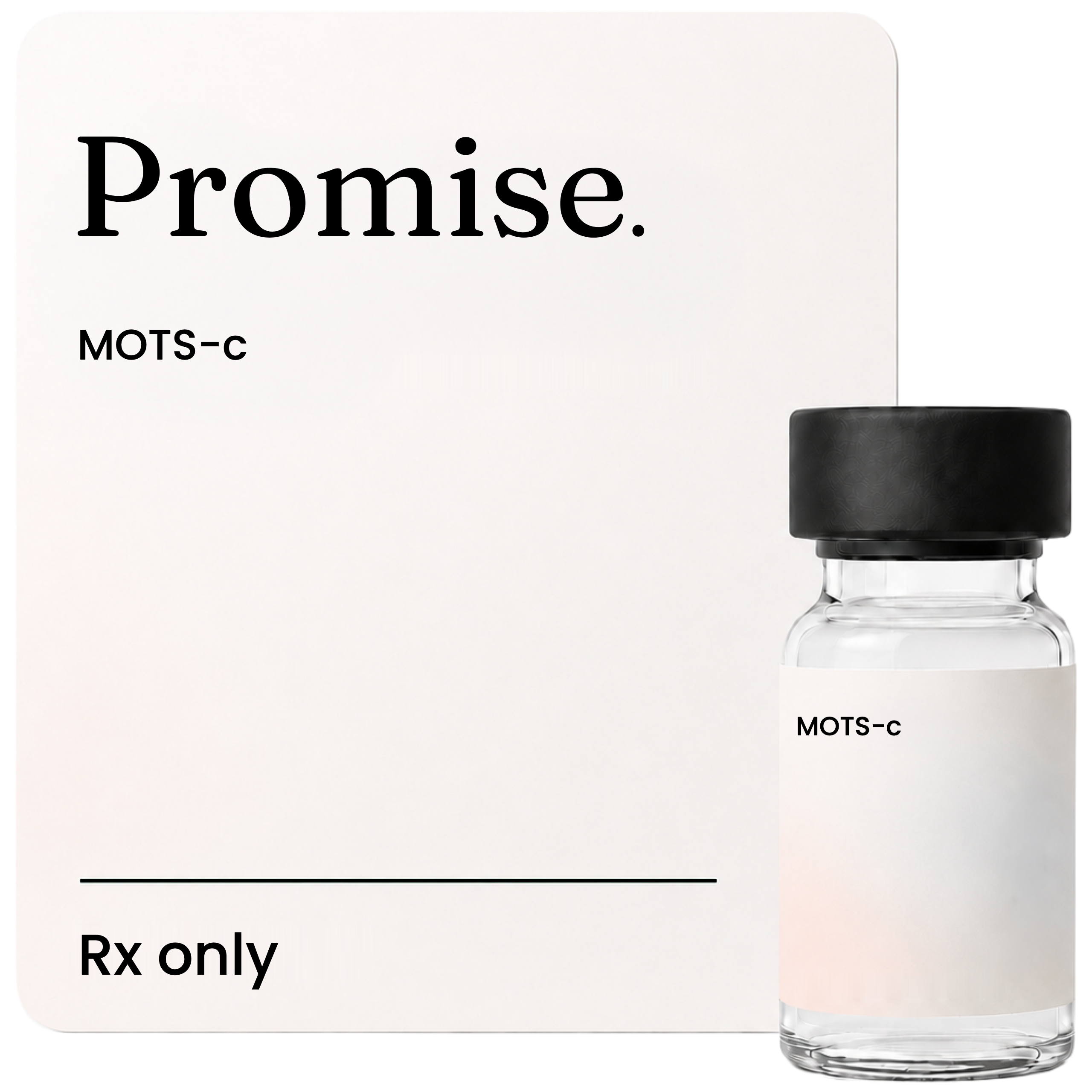
MOTS-c vial and spec card
MOTS-c · Rx only
1

Share your health history

MOTS-c has its own online clinical questionnaire — your history, medications, and goals.

2

Your answers get a careful review

A clinician reads your history and takes the time to get it right before anything is prescribed.

3

Your pharmacy ships

Compounded for your prescription and shipped cold-chain, with care-team check-ins after.

The safe way to take MOTS-c seriously

MOTS-c is easy to find online and hard to trust there. Promise works the way medicine is supposed to work — a clinician decides, a licensed pharmacy fills, and someone stays accountable to you.

A real prescription

Prescribed for you specifically, after a real look at your health history — never pulled off a shelf.

A real pharmacy

Your prescription is compounded for you by a licensed U.S. pharmacy — not a mystery vial from an unregulated website.

Real oversight

Temperature-safe shipping, follow-up check-ins, and a care team that answers — before and after your medication arrives.

Product details
Form
Injectable vial (subcutaneous), 2 mg per mL
Supply
20-day supply
Pharmacy
Compounded by a licensed U.S. pharmacy
Availability
Ships to all 50 states + D.C.; not all treatments are available in every state

Written in mitochondrial DNA

MOTS-c is one of a small family of peptides encoded not in the cell nucleus but in the mitochondrion's own genome — a signal that travels outward rather than in.

Studied through AMPK

Research interest centers on AMPK, the enzyme cells use to read their own fuel status, and on how that signal touches glucose and lipid handling.

Prescribed, never simply supplied

A licensed provider reads your history, decides whether MOTS-c fits it, and sets the protocol.

In brief.

Mitochondria carry a small genome of their own, a leftover from the bacterium they descend from. Researchers described about a decade ago that one stretch of it encodes a short peptide, MOTS-c, which appears to act as a message from the mitochondrion to the rest of the cell.

That is a genuinely interesting piece of biology, and it is also most of what is settled. Promise offers MOTS-c one way only: a licensed provider reviews your health history and prescribes it only when treatment is appropriate for you.
What MOTS-c is

MOTS-c is a chain of 16 amino acids read from a region of mitochondrial DNA, which makes it unusual — almost every peptide in the body is transcribed from nuclear DNA. It belongs to a small family called mitochondrial-derived peptides, and the interest in that family is directional. Most cellular signaling runs from the nucleus outward; these run the other way, which researchers call retrograde signaling.

The practical reading is that a mitochondrion under load may be able to report its own state, and that MOTS-c is one of the reports. Whether that observation translates into anything a person notices is a separate question, and a much less settled one.

What the research looks at

The recurring thread is AMPK, the enzyme cells use as a fuel gauge. AMPK becomes active when a cell's energy charge falls, and it shifts the cell toward producing fuel rather than storing it. Much of the MOTS-c literature examines that activation, along with related work on folate and one-carbon metabolism, which is one proposed route to it.

Downstream of AMPK, published models look at glucose handling and lipid metabolism, and some reports describe MOTS-c expression changing with exercise. All of this is mechanism. It describes what a pathway does under study conditions, not what happens in any one person, and it does not establish an outcome.

Where the evidence actually stands

Being straight about this matters more than a strong sentence would. The great majority of MOTS-c research is preclinical — cultured cells and rodent models — and the human work is small and early. Interest has run well ahead of the clinical evidence, which is common with peptides and is not by itself a verdict.

What it means in practice is that MOTS-c is a compound to consider with a clinician rather than to conclude on alone. A provider weighs it against your history, your labs where relevant, and whatever else you are doing. Sometimes the answer is a different treatment in energy and focus; sometimes the answer is none.

How it compares to NAD+ and SS-31

The three treatments in this category sit at different layers, which is worth understanding before you choose an intake form. NAD+ is a coenzyme — a substrate the energy reactions consume and regenerate, and one that sirtuins and PARP enzymes spend outright. SS-31 is a four-amino-acid peptide studied for its affinity for cardiolipin, a phospholipid of the inner mitochondrial membrane, so its research interest is structural.

MOTS-c is neither substrate nor structure. It is studied as a signal: a short peptide that appears to change what a cell does with the fuel it already has. Those are three different premises, and they do not substitute for one another.

How MOTS-c is prescribed

Everything starts with the intake questionnaire built for this specific treatment — health history, current medications, what you are trying to address. A licensed provider reads it and prescribes only if MOTS-c is a reasonable fit. Providers decline on medical grounds, and with a compound this early in its evidence, declining is a real outcome rather than a formality.

If you are prescribed, your medication is compounded and dispensed by a licensed U.S. pharmacy, and shipped in temperature-safe packaging, with follow-up check-ins from your care team. Dosing comes from the provider who evaluated you, not from a protocol found online, and any change to it happens with a clinician involved.

Common questions

What is MOTS-c?

MOTS-c is a peptide of 16 amino acids encoded within the mitochondrial genome rather than in nuclear DNA. It belongs to a small group researchers call mitochondrial-derived peptides, and it is studied as a retrograde signal — a message sent from the mitochondrion outward to the rest of the cell. Most of the published research concerns AMPK, the enzyme cells use to sense their own fuel status, and downstream questions about glucose and lipid handling. Nearly all of that work is preclinical.

Is MOTS-c FDA-approved?

No. MOTS-c is not FDA-approved. It is a compounded medication, and compounded medications are not reviewed by the FDA for safety, effectiveness, or quality. It is prepared by a licensed U.S. compounding pharmacy against a prescription written for you specifically, after a licensed provider has reviewed your health history.

How strong is the research behind MOTS-c?

Early. The peptide was described about a decade ago, and the bulk of what has been published since is cell and rodent work, with human data limited in number and size. That is worth saying plainly rather than dressing up. It means MOTS-c is a compound a clinician weighs with you against your history and your other options, not one to decide on from a summary of mechanism.

How is MOTS-c different from NAD+?

MOTS-c is a signal; NAD+ is a substrate. MOTS-c is a peptide studied for how it activates AMPK and shifts what a cell does with its fuel. NAD+ is a coenzyme the reactions themselves consume and regenerate, and it is also spent by sirtuins and PARP enzymes. Different layers of the same system, and not interchangeable — see [NAD+](/products/nad-plus) for how that one is studied. Your provider decides which, if either, fits your history.

How does the online visit work?

You start with the intake form for MOTS-c, which is its own clinical questionnaire covering your health history, medications, and goals. A licensed provider reviews your answers and prescribes only if MOTS-c is appropriate for you. If you are prescribed, your medication is compounded and dispensed by a licensed U.S. pharmacy and shipped in temperature-safe packaging, with follow-up check-ins from your care team.

Related treatments

Other Energy & Focus options a provider may consider.