Energy & Focus · Rx only

NAD+, prescribed — not just shipped.

Skip the gray-market guesswork. A licensed clinician reviews your health history, a licensed U.S. pharmacy compounds your prescription, and a care team stays with you after it ships.

$243 / mo$270 as a single month · $648 per quarter

A licensed clinician reviews every request. If NAD+ fits your health history, they write your prescription and your pharmacy takes it from there.

Licensed U.S. providers Licensed U.S. pharmacy All 50 states + D.C.

Requires an online medical evaluation. Prescribed only when a licensed provider determines it's appropriate.

A licensed clinician in a consultation room
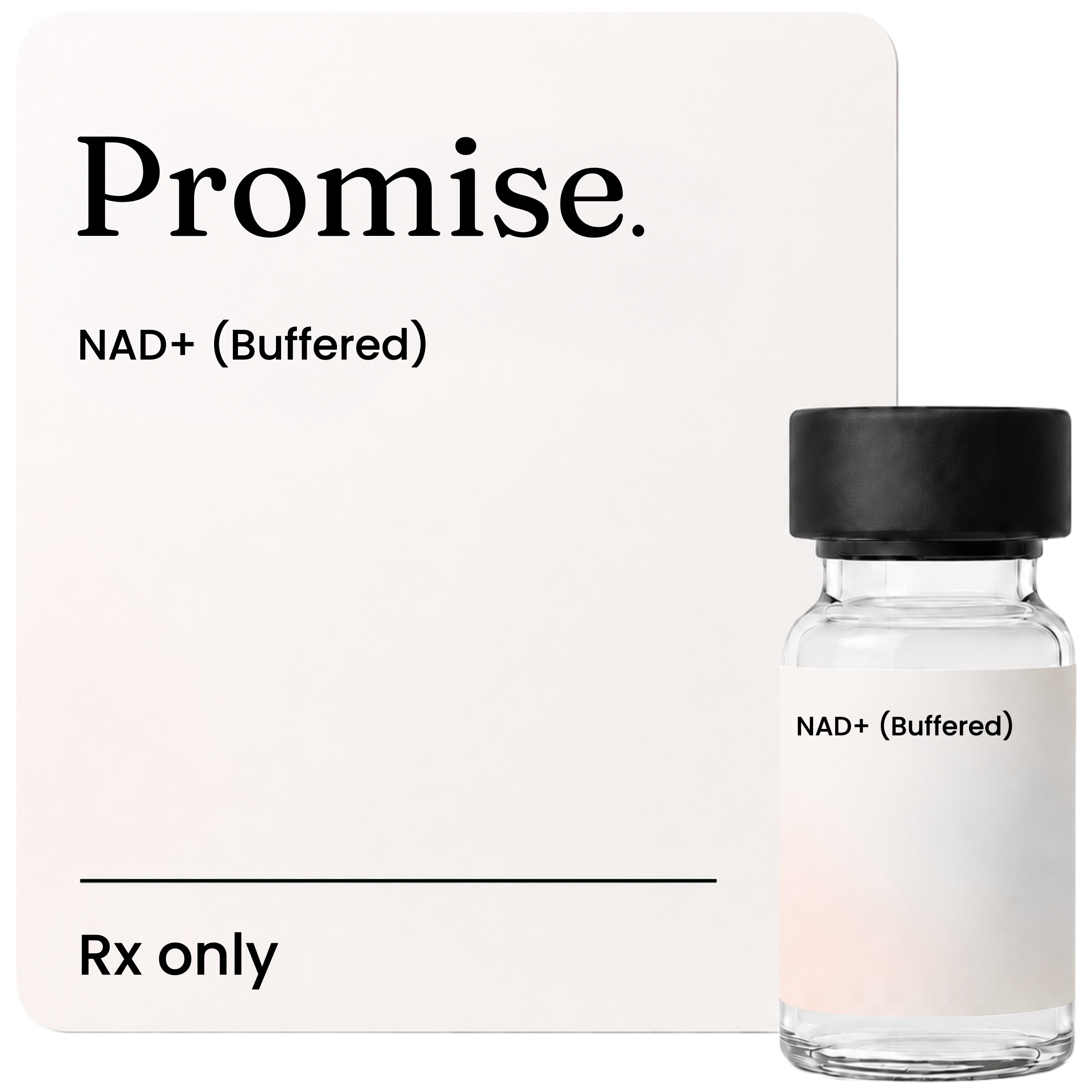
NAD+ vial and spec card
NAD+ · Rx only
1

Share your health history

NAD+ has its own online clinical questionnaire — your history, medications, and goals.

2

Your answers get a careful review

A clinician reads your history and takes the time to get it right before anything is prescribed.

3

Your pharmacy ships

Compounded for your prescription and shipped cold-chain, with care-team check-ins after.

The safe way to take NAD+ seriously

NAD+ is easy to find online and hard to trust there. Promise works the way medicine is supposed to work — a clinician decides, a licensed pharmacy fills, and someone stays accountable to you.

A real prescription

Prescribed for you specifically, after a real look at your health history — never pulled off a shelf.

A real pharmacy

Your prescription is compounded for you by a licensed U.S. pharmacy — not a mystery vial from an unregulated website.

Real oversight

Temperature-safe shipping, follow-up check-ins, and a care team that answers — before and after your medication arrives.

Product details
Form
Injectable vial (subcutaneous), 100 mg per mL
Supply
31-day supply
Pharmacy
Compounded by a licensed U.S. pharmacy
Availability
Ships to all 50 states + D.C.; not all treatments are available in every state

Chemistry the body already runs

NAD+ is a coenzyme, not a peptide. It shuttles electrons through the reactions that end in ATP, which is why it sits at the center of cellular energy metabolism.

A buffered injectable

NAD+ in solution is acidic. The formulation dispensed here is pH-adjusted by the compounding pharmacy and supplied as a 100 mg per mL vial.

Prescribed, never simply supplied

A licensed provider reads your history, decides whether NAD+ fits it, and sets the protocol.

In brief.

Cellular energy is a chemistry problem before it is a feeling. Every cell moves electrons from the fuel you eat toward the machinery that makes ATP, and nicotinamide adenine dinucleotide — NAD+ — is the carrier that does most of that shuttling. It is a coenzyme: a small molecule enzymes borrow in order to work.

Promise offers NAD+ as a buffered injectable formulation, and one way only. A licensed provider reads your health history and prescribes it only when treatment is appropriate for you.
What NAD+ actually is

NAD+ is not a peptide, which already sets it apart from most of what sits in energy and focus. MOTS-c and SS-31 are short amino-acid chains studied as signals. NAD+ is a cofactor your cells manufacture and spend continuously, and it works as a redox pair: NAD+ accepts a pair of electrons, becomes NADH, hands them to the electron transport chain, and returns to NAD+ to do it again. Glycolysis, the citric acid cycle, and fatty acid oxidation all stall without it.

Published work reports that measured NAD+ levels in several tissues decline with age, and that observation is most of the reason the molecule draws attention in longevity research. Reading it as a battery running down would be too tidy. What the literature describes is a shifting balance between the enzymes that consume NAD+ and the salvage pathways that rebuild it.

Why cells spend it

NAD+ is not only recycled — it is also cleaved. Two families of enzymes consume it outright as a substrate. Sirtuins use it to strip acetyl groups from proteins, a form of regulation that touches metabolism and gene expression. PARP enzymes use it during DNA repair, and heavy repair demand draws on that same pool. Because both bid against one shared budget, researchers tend to describe NAD+ less as a fuel and more as a currency.

That framing is why the molecule appears in anti-aging and longevity discussions as often as in metabolic ones. It is also where claims get overstated. Describing which enzymes depend on a cofactor is not the same as showing what giving that cofactor does in a person, and the human trial literature remains much smaller than the interest in it.

What energy means on this page

The category name is a fair description of the biology and a poor description of the sensation. Energy here means bioenergetics: ATP production inside mitochondria. NAD+ is not a stimulant. It has no caffeine-like action, and nothing about the mechanism predicts alertness, wakefulness, or drive.

We say that plainly because the alternative is a promise nobody can keep. A provider can tell you what is understood about the mechanism and what is not. Neither of you can know in advance how a given person responds, and the honest answer to how it will feel is that the research does not answer it.

The buffered formulation

NAD+ in solution is acidic, so the formulation dispensed through Promise is buffered — pH-adjusted by the compounding pharmacy before it reaches you. It is supplied as a 100 mg per mL injectable vial, and the strength printed on a label is not the same thing as your dose.

Dosing is set by the provider who evaluated you, based on your history and what you are working on. It is not a number to source from a forum. If your protocol needs to change, it changes with a clinician involved.

How NAD+ is prescribed

Everything starts with an intake questionnaire built for this specific treatment: health history, current medications, what brought you here. A licensed provider reads it and prescribes only if NAD+ is appropriate for you. Not everyone qualifies, and providers decline on medical grounds — that gate is the reason to do this through a clinic.

If you are prescribed, your medication is compounded and dispensed by a licensed U.S. pharmacy, and shipped in temperature-safe packaging, with follow-up check-ins from your care team. NAD+ sits on top of sleep, food, and sane training loads rather than standing in for them. It is one piece of support for a promise you already made to yourself.

Common questions

What is NAD+?

NAD+, or nicotinamide adenine dinucleotide, is a coenzyme present in every cell. It works as a redox pair: NAD+ accepts a pair of electrons, becomes NADH, passes them to the electron transport chain, and returns to NAD+ to do it again. Glycolysis, the citric acid cycle, and fatty acid oxidation all depend on that cycle. It is also consumed outright as a substrate by sirtuins and by the PARP enzymes involved in DNA repair. Published work reports that measured levels in several tissues decline with age, which is most of the reason it draws research interest.

Is NAD+ FDA-approved?

No. NAD+ as offered here is a compounded medication and is not FDA-approved. Compounded medications are not reviewed by the FDA for safety, effectiveness, or quality. It is prepared by a licensed U.S. compounding pharmacy against a prescription written for you specifically, after a licensed provider has reviewed your health history.

How does the online visit work?

You start with the intake form for NAD+, which is its own clinical questionnaire covering your health history, medications, and goals. A licensed provider reviews your answers and prescribes only if NAD+ is appropriate for you. If you are prescribed, your medication is compounded and dispensed by a licensed U.S. pharmacy and shipped in temperature-safe packaging, with follow-up check-ins from your care team.

How is NAD+ different from MOTS-c and SS-31?

They sit at three different points in mitochondrial biology. NAD+ is a cofactor — a molecule the reactions themselves consume and regenerate. MOTS-c is a 16-amino-acid peptide encoded in mitochondrial DNA and studied as a signal, mainly through AMPK. SS-31 is a four-amino-acid peptide studied for its affinity for cardiolipin, a phospholipid of the inner mitochondrial membrane, which puts its research interest on membrane structure rather than on signaling or substrate supply. Your provider decides which of the three, if any, fits your history.

Does NAD+ work like a stimulant?

No. Energy in this context means bioenergetics — the production of ATP inside mitochondria — not stimulation. NAD+ has no caffeine-like action, and nothing about its mechanism predicts alertness, wakefulness, or drive. We describe what is being studied and why; we do not tell you how it will feel, because the research does not answer that question.

Related treatments

Other Energy & Focus options a provider may consider.