Energy & Focus · Rx only

SS-31, prescribed — not just shipped.

Skip the gray-market guesswork. A licensed clinician reviews your health history, a licensed U.S. pharmacy compounds your prescription, and a care team stays with you after it ships.

$243 / mo$270 as a single month · $648 for a 3-month supply

A licensed clinician reviews every request. If SS-31 fits your health history, they write your prescription and your pharmacy takes it from there.

Licensed U.S. providers Licensed U.S. pharmacy All 50 states + D.C.

Requires an online medical evaluation. Prescribed only when a licensed provider determines it's appropriate.

A licensed clinician in a consultation room
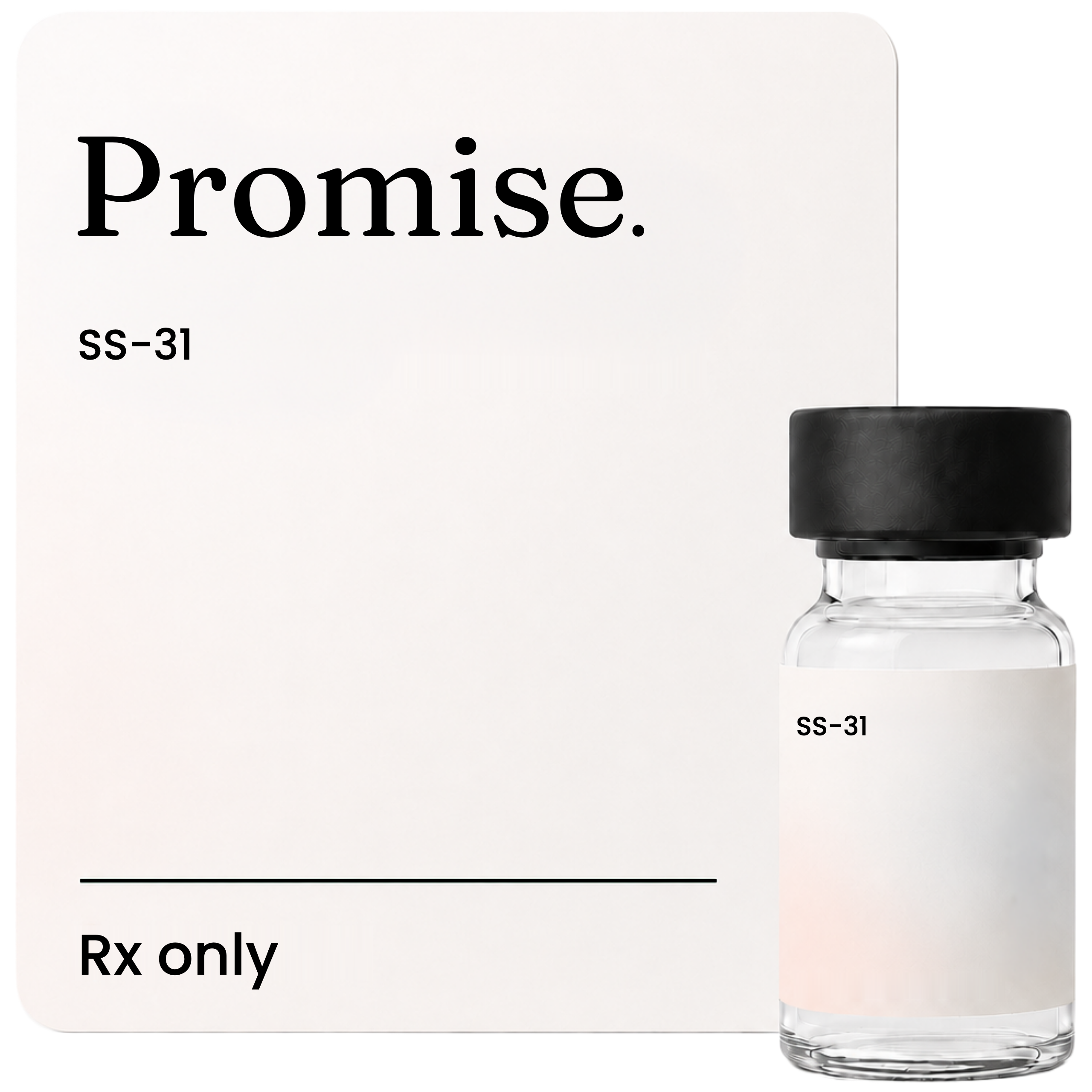
SS-31 vial and spec card
SS-31 · Rx only
1

Share your health history

SS-31 has its own online clinical questionnaire — your history, medications, and goals.

2

Your answers get a careful review

A clinician reads your history and takes the time to get it right before anything is prescribed.

3

Your pharmacy ships

Compounded for your prescription and shipped cold-chain, with care-team check-ins after.

The safe way to take SS-31 seriously

SS-31 is easy to find online and hard to trust there. Promise works the way medicine is supposed to work — a clinician decides, a licensed pharmacy fills, and someone stays accountable to you.

A real prescription

Prescribed for you specifically, after a real look at your health history — never pulled off a shelf.

A real pharmacy

Your prescription is compounded for you by a licensed U.S. pharmacy — not a mystery vial from an unregulated website.

Real oversight

Temperature-safe shipping, follow-up check-ins, and a care team that answers — before and after your medication arrives.

Product details
Form
Injectable vial (subcutaneous), 2 mg per mL
Supply
38-day supply
Pharmacy
Compounded by a licensed U.S. pharmacy
Availability
Ships to all 50 states + D.C.; not all treatments are available in every state

Studied at the membrane

SS-31 is a tetrapeptide studied for its affinity for cardiolipin, the phospholipid that gives the inner mitochondrial membrane its folded shape.

A research record in rare disease

Elamipretide has been evaluated in registered clinical trials in people with rare inherited mitochondrial conditions. Those trials describe that setting, not this compounded formulation.

Prescribed, never simply supplied

A licensed provider reads your history, decides whether SS-31 fits it, and sets the protocol.

In brief.

Most compounds discussed under the heading of cellular energy act on what a mitochondrion is doing. SS-31 is studied for something closer to how a mitochondrion is built. It is a four-amino-acid peptide, also known as elamipretide, and the research interest sits at the inner membrane, where the folded surfaces that carry the electron transport chain are held in shape.

Promise offers it one way only: a licensed provider reviews your health history and prescribes it only when treatment is appropriate for you.
What SS-31 is

SS-31 is a tetrapeptide with an alternating aromatic and cationic sequence. That pattern is the point rather than a curiosity: it gives the molecule a charge distribution that lets it concentrate in the inner mitochondrial membrane, which is one of the few places in the cell with the chemistry to attract it. Elamipretide is the name the same molecule carries in the research literature.

Compared with the other treatments in energy and focus, that gives it a distinct premise. It is not studied as a fuel and not primarily as a signal. It is studied for where it goes and what it associates with once it gets there.

Cardiolipin, and why the membrane matters

Cardiolipin is a phospholipid found almost exclusively in the inner mitochondrial membrane. It has an unusual four-tailed structure, and that shape helps produce the tight folds — cristae — that give the membrane its surface area. It also sits alongside the protein complexes of the electron transport chain, and published work describes it as helping hold their arrangement.

The research on SS-31 centers on its affinity for cardiolipin and on what that association does to membrane organization. Cardiolipin is known to change with age and under oxidative stress, which is why a molecule that binds it draws interest. Describing a binding partner is not the same as describing an outcome, and this section is mechanism, not a result.

What has been studied, and in whom

Elamipretide has a more substantial human research record than most peptides discussed in this space. It has been evaluated in registered clinical trials in people with rare inherited mitochondrial conditions, on defined endpoints, in participants carrying a specific confirmed diagnosis.

That record deserves to be reported accurately and no further. Trials in a diagnosed rare disease describe that population and the product studied in it. They say nothing about what a compounded formulation does in a person without that diagnosis, and they do not make the treatment offered here FDA-approved. What the literature supports is that the mechanism is taken seriously enough to test. That is a reason for a clinician to consider it, not a result to expect.

How it compares to the others in this category

The three treatments here approach the same organelle from different angles, and choosing between them is a clinical decision rather than a preference. NAD+ is a coenzyme: the substrate the energy-producing reactions consume and regenerate, and which sirtuins and PARP enzymes also spend. MOTS-c is a peptide encoded in mitochondrial DNA and studied as a signal through AMPK.

SS-31 is the structural one. Its studied premise is the membrane the other two depend on. None of the three substitutes for another, and it is normal for a provider to conclude that a different treatment, or none of them, is the better fit.

How SS-31 is prescribed

Everything starts with an intake questionnaire built for this specific treatment: health history, current medications, what brought you here. A licensed provider reads it and prescribes only if SS-31 is appropriate for you.

If you are prescribed, your medication is compounded and dispensed by a licensed U.S. pharmacy, and shipped in temperature-safe packaging, with follow-up check-ins from your care team. Dosing is set by the provider who evaluated you, and it changes only with a clinician involved. Treatment here is meant to support the work you are already doing to keep a promise you made to yourself, not to replace it.

Common questions

What is SS-31?

SS-31, also known as elamipretide, is a peptide of four amino acids in an alternating aromatic and cationic pattern. That structure is what lets it concentrate at the inner mitochondrial membrane, where research describes it associating with cardiolipin — a phospholipid found almost exclusively there, which helps shape the membrane's folds and organize the protein complexes of the electron transport chain. Its studied premise is structural rather than metabolic: the organization of the membrane itself.

Is SS-31 FDA-approved?

No. The SS-31 prescribed through Promise is a compounded medication and is not FDA-approved. Compounded medications are not reviewed by the FDA for safety, effectiveness, or quality. It is prepared by a licensed U.S. compounding pharmacy against a prescription written for you specifically, after a licensed provider has reviewed your health history.

Has SS-31 been studied in people?

Yes, though the setting matters. Elamipretide has been evaluated in registered clinical trials enrolling people with rare inherited mitochondrial diseases — participants with a specific confirmed diagnosis, studied on defined endpoints. Those results describe that population and that product. They do not describe what a compounded formulation does in someone without such a diagnosis, and they do not make the treatment offered here FDA-approved. Read the trial literature as evidence that the mechanism is taken seriously, not as a result you can expect.

How is SS-31 different from NAD+ and MOTS-c?

Three different layers of the same organelle. SS-31 is studied at the membrane, through its affinity for cardiolipin and the structural organization that depends on it. MOTS-c is a 16-amino-acid peptide encoded in mitochondrial DNA and studied as a signal, mainly through AMPK. NAD+ is a coenzyme — the substrate that energy reactions consume and regenerate. They are not interchangeable, and a provider decides which of them, if any, suits your history.

How does the online visit work?

You start with the intake form for SS-31, which is its own clinical questionnaire covering your health history, medications, and goals. A licensed provider reviews your answers and prescribes only if SS-31 is appropriate for you. If you are prescribed, your medication is compounded and dispensed by a licensed U.S. pharmacy and shipped in temperature-safe packaging, with follow-up check-ins from your care team.

Related treatments

Other Energy & Focus options a provider may consider.