Muscle & Recovery · Coming soon

Thymosin Beta-4, the full peptide explained.

The full peptide is studied for cell movement and tissue repair. Human findings in specific eye and skin conditions are mixed. It differs from the TB-500 fragment and is coming soon to Promise.

Coming soon

You are on the list. We will email you when Thymosin Beta-4 becomes available — and nothing else. Joining is not a medical request, and no prescription has been issued.

That did not go through. Check the address and try again.

Thymosin Beta-4 is coming soon to Promise. Add your email and we'll let you know when visits open.

We store your address and which treatment you asked about, and use it only to tell you if Thymosin Beta-4 becomes available. Joining is not a medical request and no prescription is issued from this form.

A licensed provider reviews every request; not everyone qualifies.

Prefer to talk to a person first?

Call (602) 737-2202

Open now · until 5 p.m. AZ

A licensed clinician in a consultation room

How it works once Thymosin Beta-4 is available

  1. 1

    Share your health history

    Every treatment gets its own online clinical questionnaire — your history, medications, and goals.

  2. 2

    A licensed provider reads it

    A real person goes through your history and takes the time to get it right before anything is decided.

  3. 3

    They prescribe — or they don't

    If a treatment isn't right for your history, you'll hear that plainly. That review is the whole point.

  4. 4

    Your pharmacy compounds it

    Made for your prescription by a licensed U.S. pharmacy and shipped in temperature-safe packaging.

  5. 5

    You choose whether to continue

    Your care team checks in after it arrives. Adjust with your provider, or cancel at any time.

The safe way to take Thymosin Beta-4 seriously

Thymosin Beta-4 is easy to find online and hard to trust there. Promise works the way medicine is supposed to work — a clinician decides, a licensed pharmacy fills, and someone stays accountable to you.

A real prescription

Prescribed for you specifically, after a real look at your health history — never pulled off a shelf.

A real pharmacy

Your prescription is compounded for you by a licensed U.S. pharmacy — not a mystery vial from an unregulated website.

Real oversight

Temperature-safe shipping, follow-up check-ins, and a care team that answers — before and after your medication arrives.

Product details
Availability
Coming soon — add me to the list to be notified

The whole peptide

The full peptide binds actin, a protein cells use to change shape and move. Researchers study how that interaction relates to tissue repair.

Human studies, mixed results

Human studies have tested specific eye and skin preparations, with mixed findings. Results from these settings do not establish benefits for muscle recovery.

A provider will decide

When visits open, a licensed provider will review your history and the evidence before deciding whether this peptide is appropriate. They may decline.

In brief.

Thymosin Beta-4 is a short protein your cells make, studied for cell movement and tissue repair. It is the whole peptide, not the shorter TB-500 fragment. Human trials have tested specific eye and skin preparations, with mixed results. Those studies do not establish a benefit for muscle recovery.

Thymosin Beta-4 is coming soon to Promise — add me to the list.

What thymosin beta-4 is

The full peptide contains 43 amino acids, the building blocks of proteins. TB4 is a common short name for it. TB-500 contains only seven of those building blocks, with a small chemical cap added at one end. The names are related, but the molecules are different.

The natural protein binds actin, part of the framework cells use to change shape and move. It holds individual pieces of actin before they join into longer strands. That helps explain why researchers became interested in the movement of cells around damaged tissue.

It belongs in Promise's muscle and recovery category because of that research interest. The category name does not mean human studies have established better recovery from exercise or an injury.

How it is studied to work

Cells need to build and take apart their internal framework as they move. Holding some actin pieces apart is one way the full peptide participates in that process. It is not simply a signal to make everything move faster.

Researchers have examined related questions about surface cells moving across a wound, small blood vessels forming, and inflammation signals. Much of that work uses cells in dishes or animals. A finding about how cells behave can explain a research idea without showing what a medication will do for a person.

Human trials ask a more specific question: does a particular preparation change a particular outcome in a defined group of patients? Changing the molecule or how it reaches the tissue leaves that question open again.

What the human studies show

A small dry-eye trial published in 2015 reported favorable findings at selected checks. A separate trial of 72 people with dry eye missed both main goals, although some other measurements favored the peptide. A main goal is the result chosen in advance to judge the trial.

As of October 6, 2026, the ARISE-3 trial record includes results first posted on August 28, 2026. That later dry-eye trial enrolled 700 people and also missed its main goals. Favorable findings on other measures do not erase that result.

An 18-person trial examined neurotrophic keratopathy, an eye-surface condition involving damaged nerves. Its main wound-closure comparison was not statistically clear, meaning the study did not meet its planned test for a difference. A later check favored the peptide. These registered eye-trial results concern an eye preparation, not general recovery.

Skin studies also have limits. A 73-person trial of a topical gel, applied to skin, examined venous ulcers: leg wounds linked to poor vein circulation. Its report described an exploratory wound-closure signal. A trial in 72 people examined pressure ulcers, wounds caused by prolonged pressure on skin. The registry combines the peptide groups' closure results, which did not establish an advantage over placebo, a comparison gel without the peptide.

That trial's registry also recorded serious medical events in both groups. The record does not establish that the peptide caused them.

A 30-person gel trial examined epidermolysis bullosa, an inherited condition that makes skin fragile. It stopped early and found no statistically clear wound-closure advantage. The registered main goals of these pressure-ulcer and fragile-skin trials concerned safety; wound closure was an additional question.

A 2010 study in 40 healthy volunteers gave the full peptide into a vein to examine early safety. It reported mild or moderate unwanted effects and no serious adverse events. That short study does not establish long-term safety or an injury-recovery benefit.

The full peptide vs TB-500

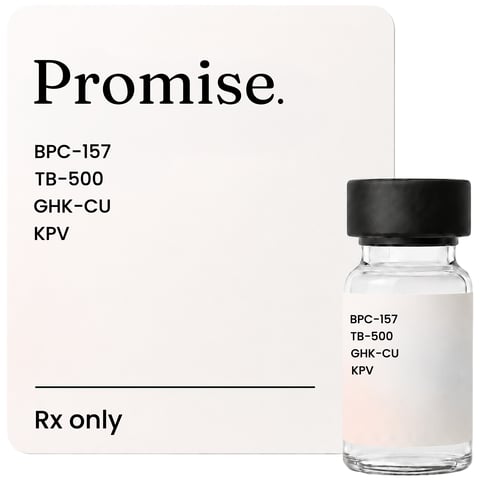
The difference is the full chain versus a short piece. A result for the whole peptide cannot establish what the fragment does. Neither does putting the fragment into a blend make the parent molecule's trials apply to it.

TB-500 is the fragment listed in Wolverine and KLOW, two blends Promise offers by prescription. Those blends do not contain the full peptide described here. The guide to the full peptide covers the biology in more depth; this page explains the coming-soon prescription path.

The FDA's compounding evaluation, a review of ingredients for medicines prepared by pharmacies, addressed the TB-500 fragment, not the full peptide. FDA identified no human exposure data for that fragment. The site's TB-500 FDA review follows that separate record.

A licensed provider may still prescribe — that decision is between you and your doctor.

How it will be prescribed

When visits open, the request will begin with the intake questionnaire written for this peptide. It will cover your health history, medicines, allergies, and the reason for your request.

A licensed provider will consider the evidence alongside your history, may ask for more information, and will prescribe or decline.

If prescribed, a licensed U.S. pharmacy will compound and dispense the medication. The formulation Promise will offer is not FDA-approved. Compounded medications are not reviewed by the FDA for safety, effectiveness, or quality.

Your provider sets any protocol; Promise does not publish dosing. Follow-up check-ins from your care team will be part of the plan, with a clinical contact for questions or unexpected reactions.

Common questions

What is Thymosin Beta-4?

It is a short protein the body makes, studied for cell movement and tissue repair. It binds actin, part of the framework cells use to change shape and move. The full peptide has been tested in specific eye and skin settings, with mixed findings. It is different from the shorter TB-500 fragment and is coming soon to Promise.

Will Thymosin Beta-4 from Promise be a real prescription?

Yes. When visits open, it will be prescribed by a licensed provider after a review of your health history and compounded for you by a licensed U.S. pharmacy. It will not be a product labeled for laboratory use. The provider will decide whether it is appropriate for you and may decline.

Does starting a visit guarantee a prescription?

A visit does not guarantee a prescription. When visits open, a licensed provider will review your health history, current medicines, and reason for requesting this peptide. They may ask for more information or decide it is not appropriate. Joining the waitlist now will only let you hear when visits open; it is not a medical evaluation.

Is Thymosin Beta-4 FDA-approved?

No. Thymosin Beta-4 is not FDA-approved, and no FDA-approved product contains it. The formulation Promise will offer is a compounded medication, which is not reviewed by the FDA for safety, effectiveness, or quality. Human trials of particular preparations do not change that status. A licensed provider will prescribe only when it is appropriate for you.

Is Thymosin Beta-4 available now?

Not yet. Thymosin Beta-4 is coming soon to Promise — add me to the list on this page and we'll email you when visits open. This page explains the compound and its evidence while you wait. Joining the list does not start a visit or establish that a prescription will be appropriate for you.

Is thymosin beta-4 the same as TB-500?

They are different molecules. The full peptide contains 43 amino acids, the building blocks of proteins. TB-500 is a synthetic fragment containing seven of them, with a small chemical cap added. Human studies of the full peptide do not establish the fragment's effects or safety. Wolverine and KLOW list the fragment, not the full peptide.

What does the research on Thymosin Beta-4 actually show?

Human trials exist, but their results are mixed and depend on the preparation and condition studied. Researchers have examined eye preparations, skin gels, and early safety when the peptide was given into a vein. Several trials missed their main goals despite favorable findings on other measurements. Cell and animal studies add biological context; they do not establish a benefit for muscle recovery.

How is this different from Thymosin Beta-4 sold online?

Provider review, pharmacy dispensing, and follow-up will be the difference. Products sold online without a prescription may be labeled for laboratory use and come without a provider reviewing your history or a pharmacy dispensing for you. When visits open, Promise's prescription path will involve those clinical steps. That oversight will not fill the gaps in the evidence.

Related treatments

Other Muscle & Recovery options a provider may consider.