Muscle & Recovery · Coming soon

Glow, done right — or not at all.

A three-peptide blend of BPC-157, TB-500 and GHK-Cu, pairing the two repair peptides with the copper-binding tripeptide studied around skin and connective tissue.

Coming soon

Promise is moving to a new prescriber network. Visits are paused while we make the switch — leave your email on any treatment page and we'll tell you when they reopen. A licensed provider will still review every request, and not everyone qualifies.

You are on the list. We will email you if Glow becomes available — and nothing else. Joining is not a medical request, and no prescription has been issued.

That did not go through. Check the address and try again.

We store your address and which treatment you asked about, and use it only to tell you if Glow becomes available. Joining is not a medical request and no prescription is issued from this form.

A licensed clinician in a consultation room
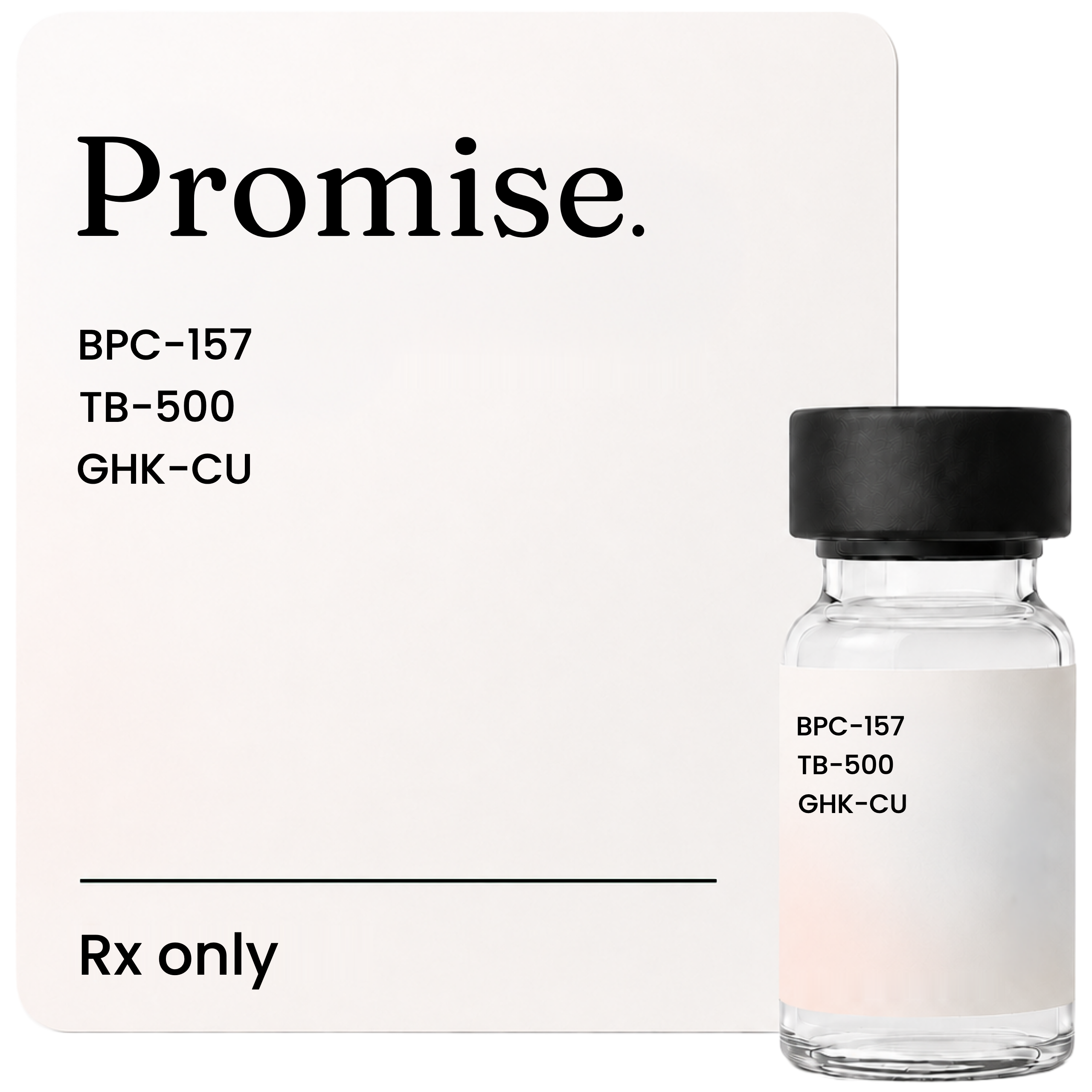
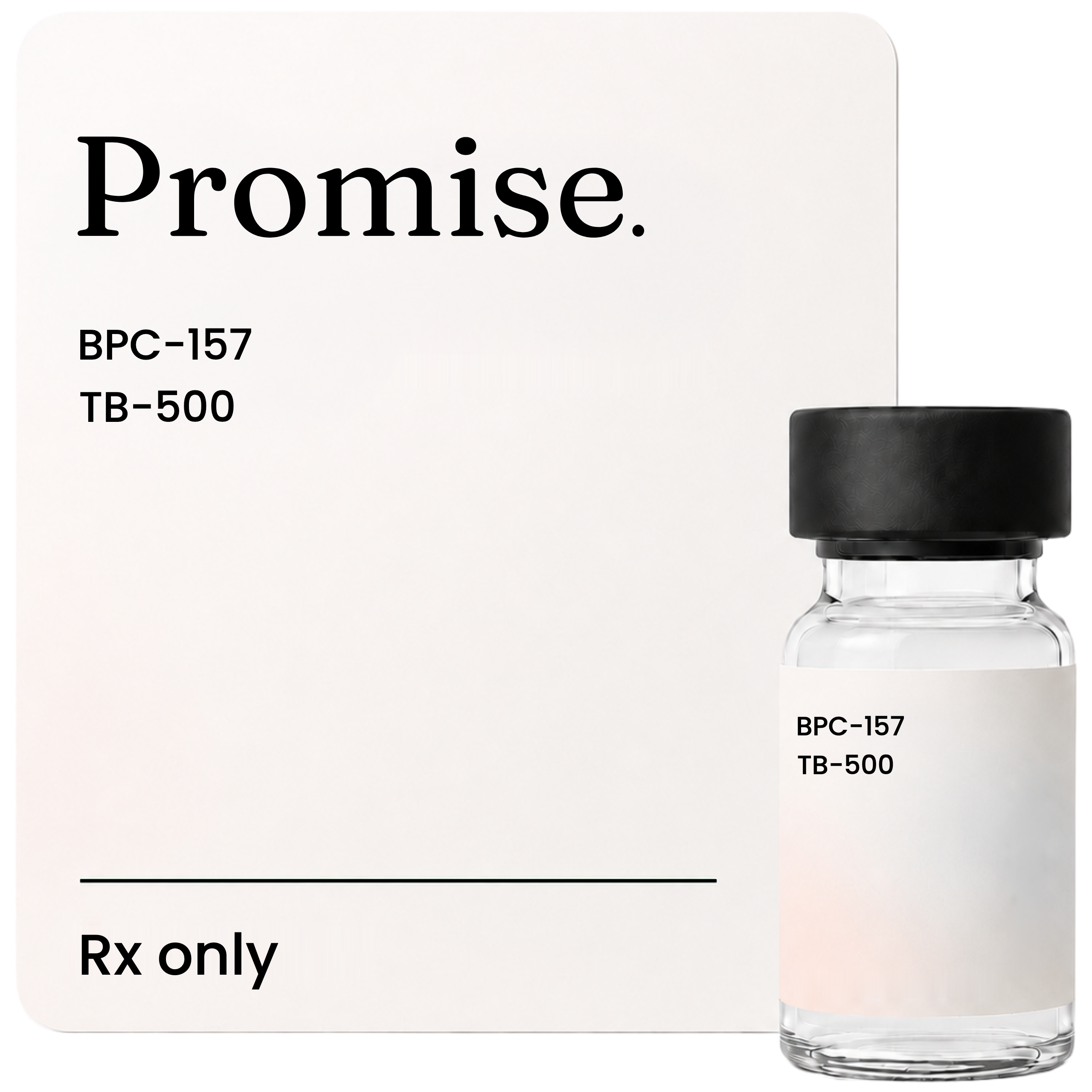
Glow vial and spec card
Glow · Coming soon

How it works once Glow is available

  1. 1

    Share your health history

    Every treatment gets its own online clinical questionnaire — your history, medications, and goals.

  2. 2

    A licensed provider reads it

    A real person goes through your history and takes the time to get it right before anything is decided.

  3. 3

    They prescribe — or they don't

    If a treatment isn't right for your history, you'll hear that plainly. That review is the whole point.

  4. 4

    Your pharmacy compounds it

    Made for your prescription by a licensed U.S. pharmacy and shipped in temperature-safe packaging.

  5. 5

    You choose whether to continue

    Your care team checks in after it arrives. Adjust with your provider, or cancel at any time.

How Glow is offered

Glow is offered as an injectable. Your provider decides whether it's appropriate — including whether a different treatment would serve you better.

  • Injectable

    9 mg / 3.33 mg per mL × 3 mL vial

The safe way to take Glow seriously

Glow is easy to find online and hard to trust there. Promise works the way medicine is supposed to work — a clinician decides, a licensed pharmacy fills, and someone stays accountable to you.

A real prescription

Prescribed for you specifically, after a real look at your health history — never pulled off a shelf.

A real pharmacy

Your prescription is compounded for you by a licensed U.S. pharmacy — not a mystery vial from an unregulated website.

Real oversight

Temperature-safe shipping, follow-up check-ins, and a care team that answers — before and after your medication arrives.

Product details
Available as
Injectable
Supply
9 mg / 3.33 mg per mL × 3 mL vial
Pharmacy
Compounded by a licensed U.S. pharmacy
Availability
Not yet available; join the waitlist to be notified

Three peptides, one formulation

BPC-157 and TB-500 are studied around repair signaling; Glow adds GHK-Cu, the copper-binding tripeptide studied around connective tissue.
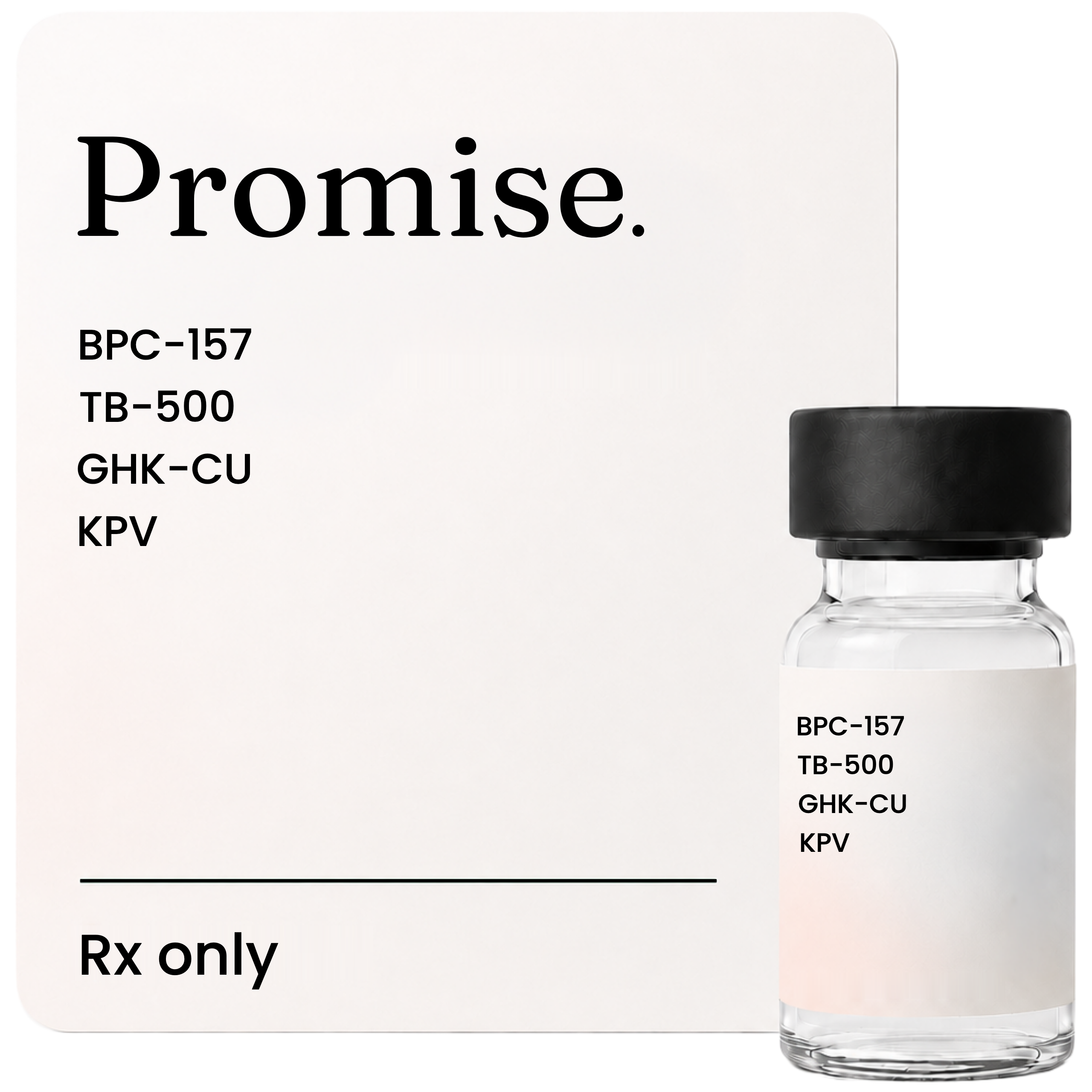
The step between our two blends

Wolverine is the BPC-157 / TB-500 pair; KLOW adds both KPV and GHK-Cu. Glow sits between them, with GHK-Cu and without KPV.

Reviewed as a combination

A licensed provider reviews the full three-peptide formulation against your history and may prescribe or decline.

In brief.

Glow is available through Promise as a three-peptide blend in a single compounded injectable: BPC-157, TB-500 and GHK-Cu. Two are the repair peptides already prescribed together as Wolverine. The third is the copper-binding tripeptide offered on its own as GHK-Cu. A licensed provider reviews every request and prescribes only when the blend is appropriate.

What Glow is

BPC-157 is a synthetic peptide based on a sequence identified in human gastric juice. Research interest in it centers on tissue-repair signaling and on angiogenesis — the formation of new small blood vessels. TB-500 is a synthetic fragment of thymosin beta-4, a protein involved in actin regulation and cell migration, studied in that same repair context from a different angle.

GHK-Cu is the outlier of the three. It is a naturally occurring tripeptide that binds a copper ion, circulates in human plasma at concentrations that fall as a person ages, and has been studied for its role in extracellular-matrix remodeling — the collagen and elastin scaffolding that holds skin and connective tissue together.

Put that together and the reasoning behind the blend is legible: two compounds studied around repair signaling, one studied around the material the body repairs with. That is a rationale. It is not a result.

Where Glow sits between Wolverine and KLOW

We already prescribe two blends in muscle and recovery. Wolverine is the pair — BPC-157 and TB-500, nothing else. KLOW is the wider formulation, adding KPV and GHK-Cu on top of that pair.

Glow is the step between them: the Wolverine pair with GHK-Cu added, and without KPV. A provider considers whether that narrower combination, another formulation or no peptide fits the person’s history.

None of this is a ranking. A wider blend is not a stronger one, and a narrower blend is not a beginner's version. Which formulation suits a person is a clinical judgment about their history and their other medications.

What the research covers, and what it does not

It is worth being clear-eyed here. The published work on BPC-157 and TB-500 is overwhelmingly preclinical — animal models and laboratory studies — with very little controlled human data behind it. GHK-Cu has a longer dermatology literature, but most of that concerns topical formulations rather than a compounded injectable.

A blend inherits every one of those limits and adds one of its own: three compounds studied separately have not been studied much together. Combining them is a clinical decision made about a particular person, not a conclusion the literature has already reached.

We would rather set that out plainly than let it go unsaid.

How Glow is prescribed

Everything starts with an intake questionnaire written for this formulation. It covers your health history, current medications, the issue you are trying to address, and factors a clinician needs before considering several active ingredients together.

A licensed provider reads the intake and decides. They may prescribe Glow, ask for more information, recommend a narrower option, or decline. Not everyone qualifies, and the ability to say no is part of what makes this medical care rather than simple supply.

What treatment looks like

If Glow is prescribed, the injectable medication is compounded and dispensed by a licensed U.S. pharmacy. The provider sets the protocol; the strength on the product is a fact about the vial, not an instruction for how much or how often to use it.

The medication ships in temperature-safe packaging, and follow-up check-ins keep a clinician involved. Glow is intended to sit alongside sleep, nutrition, rehabilitation and appropriately scaled training rather than replace them.

Common questions

What is Glow?

Glow is a three-peptide blend: BPC-157, TB-500 and GHK-Cu in a single compounded injectable vial. BPC-157 and TB-500 are studied around repair signaling, while GHK-Cu is studied for extracellular-matrix remodeling — the collagen and elastin scaffolding of skin and connective tissue. Glow is available only by prescription after a licensed provider reviews your history.

Is this real Glow, or a research chemical?

A real prescription. Glow on Promise is prescribed by a licensed provider after a review of your health history and compounded for you by a licensed U.S. pharmacy. It is not a product labeled for laboratory use.

Does starting a visit guarantee a prescription?

No. A licensed provider reviews every Glow request and prescribes only when it is appropriate for you. If it isn't, you'll be told plainly — that review is the point.

How does Glow differ from Wolverine and KLOW?

Wolverine is BPC-157 and TB-500 together, and nothing else. KLOW is the wider formulation, adding KPV and GHK-Cu on top of that pair. Glow is the step between them — the Wolverine pair with GHK-Cu added, without KPV. A wider blend is not a stronger one and a narrower blend is not a starter version; which formulation suits a person is a clinical judgment about their history, not a tier they select.

Is Glow FDA-approved?

No. Glow is not FDA-approved. It is prepared as a compounded medication, and compounded medications are not reviewed by the FDA for safety, effectiveness, or quality. A licensed provider prescribes it only when appropriate.

Do I need a prescription for Glow?

Yes. Everything Promise offers is prescription-only, and Glow is no exception. You complete an intake questionnaire written for this specific formulation, a licensed provider reviews your health history and medications, and they prescribe only if Glow is appropriate for you.

How strong is the research behind Glow?

The evidence is thinner than interest in the blend suggests. Much of the BPC-157 and TB-500 literature is preclinical, and much of the GHK-Cu literature concerns laboratory or topical research rather than a compounded injectable. Studying the ingredients separately is not the same as studying the three together.

How is this different from Glow sold online?

Glow sold online without a prescription is usually labeled for laboratory use, with no provider, no pharmacy, and no one accountable if something goes wrong. Promise uses a licensed provider review, a patient-specific prescription when appropriate, and a licensed U.S. compounding pharmacy.

Related treatments

Other Muscle & Recovery options a provider may consider.